
Should I have any valve seals?
Discussion


Also - while we're talking valves, there's no problem gritblasting the valve heads is there?
I hope not!
I built myself this from the frost kit - it took me bloody ages but what a great bit of kit now it's done.
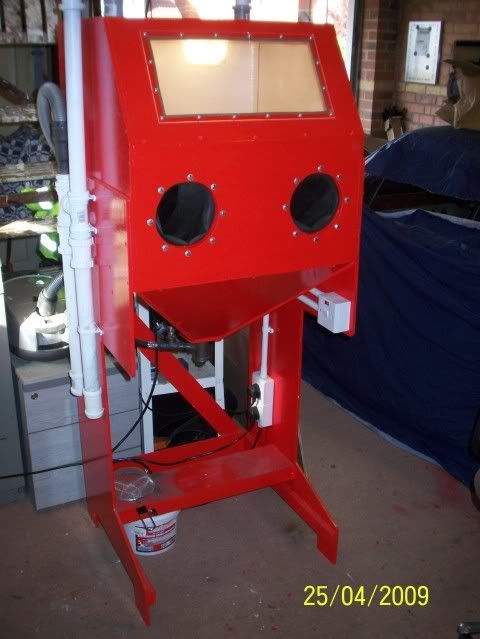
About 2-3 minutes a valve I reckon, and thats partly cos I need to let my poor little compressor catch up a bit.
This is an exhaust valve from my 3.9 V8.


I hope not!
I built myself this from the frost kit - it took me bloody ages but what a great bit of kit now it's done.
About 2-3 minutes a valve I reckon, and thats partly cos I need to let my poor little compressor catch up a bit.
This is an exhaust valve from my 3.9 V8.
Edited by Barkychoc on Friday 1st May 10:39
Barkychoc said:
Also - while we're talking valves, there's no problem gritblasting the valve heads is there?
I hope not!
I built myself this from the frost kit - it took me bloody ages but what a great bit of kit now it's done.
About 2-3 minutes a valve I reckon, and thats partly cos I need to let my poor little compressor catch up a bit.
This is an exhaust valve from my 3.9 V8.
Superb! I want one for my garage but I need a compressor first, and a lift and a......I hope not!
I built myself this from the frost kit - it took me bloody ages but what a great bit of kit now it's done.
About 2-3 minutes a valve I reckon, and thats partly cos I need to let my poor little compressor catch up a bit.
This is an exhaust valve from my 3.9 V8.
Edited by Barkychoc on Friday 1st May 10:39
I wouldn't bother, there are quite a few early heads that still look nice & fresh.
I suspect more problems are encountered with seals due to the breathing and possibly heat effect on old rubber washers I've run them and inside is all still lovely gold oil colour + no smoke, but I guess how good the stem / guide tolerance is will be a major factor, so assuming early heads have 'nicer' guides already? I certainly wouldn't rush out to use hooded seals just because the later engines use them...
The larger valves that fit on the existing seats (1.63/1.4 IIRC) and a proper seat cutting would top of my budget list for std heads. Go and see Peter B if you want Chris, not far from you. Just recently been comparing some 10 bolt serp and 14 bolt preserp heads recently and the quality of casting is amazing - you see massive differences in cast fash around significant drain areas. I was really surprised how poor the 'raw material' of the later heads were in comparison.
I suspect more problems are encountered with seals due to the breathing and possibly heat effect on old rubber washers
I've run them and inside is all still lovely gold oil colour + no smoke, but I guess how good the stem / guide tolerance is will be a major factor, so assuming early heads have 'nicer' guides already? I certainly wouldn't rush out to use hooded seals just because the later engines use them... The larger valves that fit on the existing seats (1.63/1.4 IIRC) and a proper seat cutting would top of my budget list for std heads. Go and see Peter B if you want Chris, not far from you. Just recently been comparing some 10 bolt serp and 14 bolt preserp heads recently and the quality of casting is amazing - you see massive differences in cast fash around significant drain areas. I was really surprised how poor the 'raw material' of the later heads were in comparison.
Interesting, So do you think it'd be better to base a budget performance build on some early heads and squeeze in the largest valves you can? This is kind of what I'm planning on my 4.3 but not to use std rover valves rather look at something more modern with a 6mm stem.
The reason I was saying switch over to colsibro guides is mainly the drop in friction they offer over the cast iron types.
The reason I was saying switch over to colsibro guides is mainly the drop in friction they offer over the cast iron types.
If the exterior cast lines look so crap, I can only imagine the internal water ways might be all over the place... Do you feel lucky?
430 heads (not BV but ported nearly as well as the BV heads) would be my choice of raw material as a starting point, you also get the compression rings - but then raising compression means taking it off the block... 6/1 v half dozen... I used to think thinner valve stems would be advantageous but was put off a bit so that is way at the end of the list at the mo. Many experts seem to concentrate more on the de-shrouding to get the max of partial lift flow and don't really see the stem width affecting this as much as valve and throat shape from what I gather. Heat management in that area is also quite critical, valve face is likely to get more heat (its going to be bigger?) and the reduced dia stem is the main way its getting conducted away.... I suspect this may be some of the reasoning that TVR stuck those blinking great valve guides in the later BV heads? I am still not convinced that really!!! large valves will be detrimental even though there is an element of shrouding due to proximity to the bore, so will test it one day eventually...
430 heads (not BV but ported nearly as well as the BV heads) would be my choice of raw material as a starting point, you also get the compression rings - but then raising compression means taking it off the block... 6/1 v half dozen... I used to think thinner valve stems would be advantageous but was put off a bit so that is way at the end of the list at the mo. Many experts seem to concentrate more on the de-shrouding to get the max of partial lift flow and don't really see the stem width affecting this as much as valve and throat shape from what I gather. Heat management in that area is also quite critical, valve face is likely to get more heat (its going to be bigger?) and the reduced dia stem is the main way its getting conducted away.... I suspect this may be some of the reasoning that TVR stuck those blinking great valve guides in the later BV heads? I am still not convinced that really!!! large valves will be detrimental even though there is an element of shrouding due to proximity to the bore, so will test it one day eventually...
I found de-shrouding the valves as much as possible on the last RV8 I built definitely advantageous, but a smaller valve stem always works as well in my experience.
Don't know if you read practical performance car but they've just been down this route with a ford crossflow head (so about right for comparison of the technology) and while they did some porting as well they didn't increase valve diameter and got a pretty respectable 10-12% gain in flow across most of the lift range going from a 9mm to 6mm stem.
Don't know if you read practical performance car but they've just been down this route with a ford crossflow head (so about right for comparison of the technology) and while they did some porting as well they didn't increase valve diameter and got a pretty respectable 10-12% gain in flow across most of the lift range going from a 9mm to 6mm stem.


You should have waisted stems which must be factored into the flow.. I certainly think 7mm is the limit for these long valves. Even Dave Baker commented on here this week about the inherent problems cutting seats accurately with narrower and shorter guides... In terms of bang/buck and reliability you can go way beyond sense & reason if you have the pockets & and accept the risks , but I certainly don't feel comfortable discussing such things on PH. You never know who will take something 'as read' 
I have to say apart from my dodgy cam I have no issues with the internal condition of the engine - very nice in fact.
I got made redundant last month so I'm just pottering about cleaning stuff at the moment but basically not spending any cash - so its pretty likely the engine will have to be spared upgrades for the time being.
One day.....
I got made redundant last month so I'm just pottering about cleaning stuff at the moment but basically not spending any cash - so its pretty likely the engine will have to be spared upgrades for the time being.
One day.....
Gassing Station | Chimaera | Top of Page | What's New | My Stuff