
Corner weighting a m3 evo
Discussion


In the basic sense, it's putting all 4 wheels on scales and finding out the weight distribution.
In the motorsport sense, it actually means moving stuff around to get everything balanced how you want it.
You'd probably need to find a local race prep garage to get it one the scales though.
In the motorsport sense, it actually means moving stuff around to get everything balanced how you want it.
You'd probably need to find a local race prep garage to get it one the scales though.
Imagine sitting on a 4 legged chair on a perfectly flat surface. If your chair is able to rock, or leans in a paricular direction then all 4 legs are not taking an equal load to one another in supporting the mass on the chair.
If you were to put a set of bathroom scales under each leg of the chair they would read differently depending on which legs were longer, and therefore doing more of a supporting role. If you were to sand a few millimetres (or less) from the ends of the longest legs (doing most of the work initially with a diagonal inbalance) you could balance the chair on the scales so that all 4 corners were supporting the same amount of the total weight
If the mass that was sat on the chair was not uniformly distributed over the surface, and was biased front/back, left/right, or both, the lengths of legs of the chair could be altered to share the load more uniformly across the legs. In this case, however, instead of shortening the more heavily weighted legs (the front ones if you sat at the front of the chair for example), the lighter loaded rear legs would be shortened to move the vertical direction that the mass is acting through away from the front legs, and towards the back of the chair.
Corner weighting a car is a similar principle, and is not only very interesting, it is highly rewarding in terms of both satisfaction and stability/speed. This is especially true for track cars using slick tyres that can be very sensitive to geometry tweeks.
A car on some corner weighing scales.
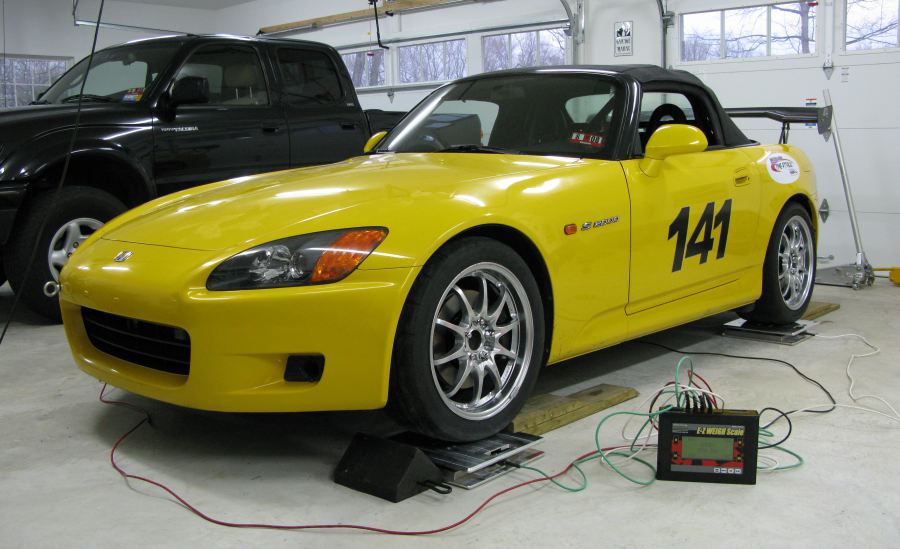
Appologies if the chair analogy comes across as patronising, but it worked for me when I was learning.
If you were to put a set of bathroom scales under each leg of the chair they would read differently depending on which legs were longer, and therefore doing more of a supporting role. If you were to sand a few millimetres (or less) from the ends of the longest legs (doing most of the work initially with a diagonal inbalance) you could balance the chair on the scales so that all 4 corners were supporting the same amount of the total weight
If the mass that was sat on the chair was not uniformly distributed over the surface, and was biased front/back, left/right, or both, the lengths of legs of the chair could be altered to share the load more uniformly across the legs. In this case, however, instead of shortening the more heavily weighted legs (the front ones if you sat at the front of the chair for example), the lighter loaded rear legs would be shortened to move the vertical direction that the mass is acting through away from the front legs, and towards the back of the chair.
Corner weighting a car is a similar principle, and is not only very interesting, it is highly rewarding in terms of both satisfaction and stability/speed. This is especially true for track cars using slick tyres that can be very sensitive to geometry tweeks.
A car on some corner weighing scales.
Appologies if the chair analogy comes across as patronising, but it worked for me when I was learning.
mrmr96 said:
Would you actually balance a car by "making the legs longer and shorter" (i.e. ride height?) or by moving heavy stuff about? Or a combination of both?
Either, both and everything!When building the car in the first place, all of the masses will be mounted as centrally (Left/right and front/back), and low as possible, however they can be manipulated to tweek the balance. For a saloon car / rally car where the driver sits to one side of the centre of the car, his mass can be mechancally balanced by mounting heavy items like some fluid tanks, and the battery to the opposite side of the car. It's essential that a car is corner weighted with the crew aboard. I am a couple stone lighter than my mate that I used to co drive for, and therefore mounted directly behind me (in a box) was the battery, and the fire extinguisher used to sit under my calfs infront of the seat .... We mounted the seat rails for my seat into channels we had cut into the floor with a protective skid plate underneath, and I could barely see out .... sometimes I didn't want to see out.
In formulae where there is a minimum weight stipulated (most single seat, and one make series), then cars are not simply stripped until they get to that weight. Every single last gram that can be extracted from the car is removed until it is as light as possible with the driver and "race finish" fluids aboard. The car is then fitted with heavy plate balast in strategic points to get back up to racing weight, typically between the axles and offset to balance the driver.
Thanks for the answers, but you've both only mentioned "moving stuff about" in your answers. Neither of you mentioned altering ride heights to change the corner weights, and this was the option which surprised me the most.
Can you clarify exactly what you can do with ride heights to manipulate corner weights without upsetting the way the car sits?
I would imagine that if the drivers side is too heavy then you would move heavy stuff to the passenger side. But the "stool" analogy seemed to suggest that an alternative could be to make the suspension longer on the passenger side so it bore more of the weight. But then the car wouldn't sit flat!
Sorry for newbie questions but this is an area I feel that I don't presently understand.
Can you clarify exactly what you can do with ride heights to manipulate corner weights without upsetting the way the car sits?
I would imagine that if the drivers side is too heavy then you would move heavy stuff to the passenger side. But the "stool" analogy seemed to suggest that an alternative could be to make the suspension longer on the passenger side so it bore more of the weight. But then the car wouldn't sit flat!
Sorry for newbie questions but this is an area I feel that I don't presently understand.
mrmr96 said:
Thanks for the answers, but you've both only mentioned "moving stuff about" in your answers. Neither of you mentioned altering ride heights to change the corner weights, and this was the option which surprised me the most.
Can you clarify exactly what you can do with ride heights to manipulate corner weights without upsetting the way the car sits?
I would imagine that if the drivers side is too heavy then you would move heavy stuff to the passenger side. But the "stool" analogy seemed to suggest that an alternative could be to make the suspension longer on the passenger side so it bore more of the weight. But then the car wouldn't sit flat!
Sorry for newbie questions but this is an area I feel that I don't presently understand.
My first explanation using the analogy of a chair aimed to illustrate what is possible by altering the lengths of the legs (the ride height at the corners)Can you clarify exactly what you can do with ride heights to manipulate corner weights without upsetting the way the car sits?
I would imagine that if the drivers side is too heavy then you would move heavy stuff to the passenger side. But the "stool" analogy seemed to suggest that an alternative could be to make the suspension longer on the passenger side so it bore more of the weight. But then the car wouldn't sit flat!
Sorry for newbie questions but this is an area I feel that I don't presently understand.
Say you balanced your car and you came up with weights like this
Front L - Front R
250 - 210
Rear L - Rear R
210 - 250
This car is heavy across the diagonal, so the front left and rear right is pushing into the ground harder than the other two wheels ..... The chair legs are longer on the front l and the rear r. Adjusting the ride height of these corners down (shortening the legs to lift the pressure of the tyre off of the ground) will level out this imbalance to match all 4 corners.
Front L - Front R
300 - 300
Rear L - Rear R
200 - 200
For this car the diagonals are perfectly matched, as is the balance left to right. The car is nose heavy, however. This is most likely a front engined car, and a 60:40 front to rear ratio isn't the end of the world. Weight can by centred closer to the rear of the car by either lowering the rear and/or raising the front. With a front engined car you are unlikely to ever get to a 50:50 split no matter what the brochure will tell you.
As far as the car being flat and level, we are only talking about a few millimetres here and there, and also only when the car is static. Yaw and pitch angles when the car is in motion will move the weight around and change the distribution between the tyres on the road ..... Now we're getting into spring rates and damper rates, and that is another kettle of fish all together.
There are some very informative books you can buy in the Haynes range regarding all aspects of race car building and setup. Terms like camber, castor, yaw, toe, roll centre etc etc etc need no longer be gobbledegook. Definitely worth a look for the Xmas present list.
Edited by mat205125 on Thursday 13th August 12:36
ves-sportni said:
What is corner weighting & where do you get it done ???
Remember you only need to corner weight a car when you've fitted coilovers as it's the ride height adjustment that is set individually.In an e36 M3, the heavy 6-cyl block is mounted almost lying on its side with the weight biased towards the right. This is balanced in a Euro spec car by the driver, pedalbox, steering equipment being on the left. In a UK spec car it is exacerbated.
I had coilovers fitted in February prior to a visit to the 'ring on Easter weekend. On the saturday morning I noticed that already I was faster than previous trip with the new suspension but had been told about corner-weighting. I had arranged with RSR Nurburg to see them in the afternoon to get this done. They set the car up on the weights with 1/2 a tank of fuel (optimum) and me sat in the driver's seat. Took about 2.5hrs to complete then Chris (their mechanic) test drove it and altered all my damping and reboundsettings on some rought roads nearby.
Sunday morning I was immediately 45 secs a lap quicker and the car felt incredible. It still does, I have so much more confidence in it on the road than I ever had in standard setup. The handling is frankly, staggering! Best money I ever spent on a car!

Wouldn't do you any good if I did have them. My car is set at a reasonably standard ride height as was living in London at the time with speed humps everywhere. As soon as I go to lower it it'll need re-doing. Also, it's likely I'm a different weight to you and when you have yours done you wouldn't have exactly the same amount of fuel in the car so even a few kilos difference makes a difference to the settings.
My car was up down up down up down onto the scales with tiny tweeks until it was perfect.
Damping settings on my GAZ Gold kit I 'think' are 75 out of 100 clicks positive a the rear and 50 out of 75 clicks positive on the fronts. I will have to check this. Also running 3 degrees negative camber on the front wheels.
My car was up down up down up down onto the scales with tiny tweeks until it was perfect.
Damping settings on my GAZ Gold kit I 'think' are 75 out of 100 clicks positive a the rear and 50 out of 75 clicks positive on the fronts. I will have to check this. Also running 3 degrees negative camber on the front wheels.
Edited by E36GUY on Thursday 13th August 22:57
Did mine on the corner weights when fitted coilovers, as wrtitten above as stock there is too much on the drivers side, even sans driver & with the softy softy springs is one of the reasons they are understeery pigs as stock on track. Even cheap coilovers are such an improvement.
But its not essential if when you fit coilovers you aim for the pooky advice set up ride heights hub to wheel arch fr 320 re 305 its a good base.
I run that front (is low for road use tho) but can't get quite that low on the rear, as my coilies wont go that low, (I have the corner weights & ride heights at home away tracking in sunny south france at mo Val de Vinne, Mas de Clos, Monay is great will post up the info when im back) & mine is great & near ideal for a sometimes driver only & passenger compramise & at present trimmed road car. tail happy solo & light on fuel less so with a pass & bit understeery full ful & pas, ok not ideal but fair compromise i feel. (running v similar sprimg rates to regular pss9 st up at mo)
Mines 3.0 tho so tad lighter for gearbox
But its not essential if when you fit coilovers you aim for the pooky advice set up ride heights hub to wheel arch fr 320 re 305 its a good base.
I run that front (is low for road use tho) but can't get quite that low on the rear, as my coilies wont go that low, (I have the corner weights & ride heights at home away tracking in sunny south france at mo Val de Vinne, Mas de Clos, Monay is great
will post up the info when im back) & mine is great & near ideal for a sometimes driver only & passenger compramise & at present trimmed road car. tail happy solo & light on fuel less so with a pass & bit understeery full ful & pas, ok not ideal but fair compromise i feel. (running v similar sprimg rates to regular pss9 st up at mo)Mines 3.0 tho so tad lighter for gearbox

I was going to fit bilstein shocks with eibach springs, but after reading this im going to buy coilovers the spring & shock combination above was mentioned on evolve motorsport website. Can anyone recomend a set of coilovers... Its for a 99 e36 m3 evo.
Edited by ves-sportni on Saturday 15th August 12:42
ves-sportni said:
I was going to fit bilstein shocks with eibach springs, but after reading this im going to buy coilovers the spring & shock combination above was mentioned on evolve motorsport website. Can anyone recomend a set of coilovers... Its for a 99 e36 m3 evo.
I'm running GAZ Gold coilovers which are very well priced and work a treat. There are more expensive items out there and KW are considered to be the best but I guess it depends on your budget capability. GAZ are run by several members here successfully. It will cost about a grand for the kit and it'd be worth investing in the adjustable camber casters too for the fronts. Don't go for anything that's cheaper than GAZEdited by ves-sportni on Saturday 15th August 12:42
Gassing Station | M Power | Top of Page | What's New | My Stuff