
Welding stainless steel
Discussion


I have a section of exhaust pipe which is stainless steel and uses flange to olive type fittings, but there is a small crack around the edge of the flange, possibly caused by a dodgey engine mount allowing the engine to rock under load and stressing the pipe.
Can this be welded or brazed back up? It's still fairly strong now, it'd probably go another 3 months like it is, but I need to get some strength back into it. I've been told welding stainless steel is not straight forward. Any thoughts?
Can this be welded or brazed back up? It's still fairly strong now, it'd probably go another 3 months like it is, but I need to get some strength back into it. I've been told welding stainless steel is not straight forward. Any thoughts?
Anyone can weld it, its only steel.
You do not need TIG, or anything fancy. Just MIG it and job done, whether with stainless wire or mild steel wire.,
Obviously if its mild steel wire, in a few hundred years it might rust away.
Or you could braze it the exact same way you braze any other metal.
You do not need TIG, or anything fancy. Just MIG it and job done, whether with stainless wire or mild steel wire.,
Obviously if its mild steel wire, in a few hundred years it might rust away.
Or you could braze it the exact same way you braze any other metal.
MIG is the work of the Devil  Ask a skilled welder to do the repair. He should drill a 1.6mm hole at each end of the crack to prevent any creepage durng the welding process. He would then TIG weld over the crack using a filler wire of the same grade as the parent metal, probably 304L. Personally I would also apply an argon back purge to ensure that the internal finish is clean and smooth without any black snot.
And No, not anybody can do it.
Ask a skilled welder to do the repair. He should drill a 1.6mm hole at each end of the crack to prevent any creepage durng the welding process. He would then TIG weld over the crack using a filler wire of the same grade as the parent metal, probably 304L. Personally I would also apply an argon back purge to ensure that the internal finish is clean and smooth without any black snot.And No, not anybody can do it.
Edited by NTEL on Sunday 16th August 01:59
NTEL said:
MIG is the work of the Devil Ask a skilled welder to do the repair. He should drill a 1.6mm hole at each end of the crack to prevent any creepage durng the welding process. He would then TIG weld over the crack using a filler wire of the same grade as the parent metal, probably 304L. Personally I would also apply an argon back purge to ensure that the internal finish is clean and smooth without any black snot.
And No, not anybody can do it.
Having welded it for years using both mild and stainless wire, and I'm crap at it. I would say anyone could do it. In fact, its easy. Ask a skilled welder to do the repair. He should drill a 1.6mm hole at each end of the crack to prevent any creepage durng the welding process. He would then TIG weld over the crack using a filler wire of the same grade as the parent metal, probably 304L. Personally I would also apply an argon back purge to ensure that the internal finish is clean and smooth without any black snot.And No, not anybody can do it.
Edited by NTEL on Sunday 16th August 01:59
Having seen dozens of silencer boxes constructed with MIG, clearly MIG is ideal for mass produced items.
TIG just looks nicer. Doesnt mean its any better for the job in hand.
Its an exhaust he's looking welded, not a bloody space shuttle.
Edited by stevieturbo on Sunday 16th August 10:31


For cracked Stainless exhausts all you need to do is drill the ends of the cracks, then zip it up using a MIG with Stainless wire and Argon as your sheild gas, if you doing this at home, Machine Mart do .5kg rolls of Stainless for about £18 and mini bottles of argon that should be more than adequate for a repair 
DIY MIG is fine with stainless wire and the correct gas (Argon, not CO2).
I can't take credit for the headers, but the collectors onward are my own efforts from a boxload of bends and straight pipe. Spent ages grinding and polishing only to find the whole lot has gone blue now. Anyway, it's not difficult.
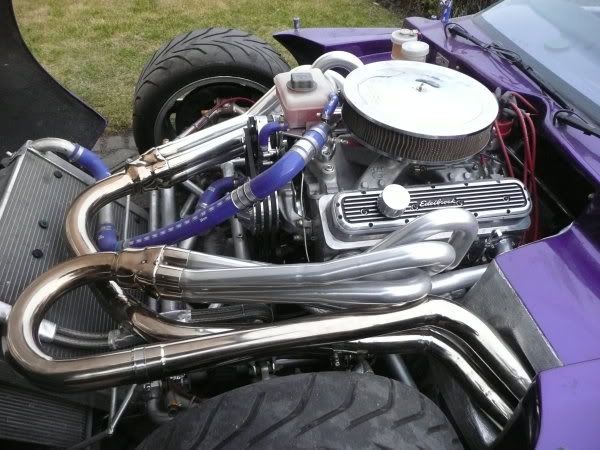
I can't take credit for the headers, but the collectors onward are my own efforts from a boxload of bends and straight pipe. Spent ages grinding and polishing only to find the whole lot has gone blue now. Anyway, it's not difficult.

stevieturbo said:
NTEL said:
MIG is the work of the Devil Ask a skilled welder to do the repair. He should drill a 1.6mm hole at each end of the crack to prevent any creepage durng the welding process. He would then TIG weld over the crack using a filler wire of the same grade as the parent metal, probably 304L. Personally I would also apply an argon back purge to ensure that the internal finish is clean and smooth without any black snot.
And No, not anybody can do it.
Having welded it for years using both mild and stainless wire, and I'm crap at it. I would say anyone could do it. In fact, its easy. Ask a skilled welder to do the repair. He should drill a 1.6mm hole at each end of the crack to prevent any creepage durng the welding process. He would then TIG weld over the crack using a filler wire of the same grade as the parent metal, probably 304L. Personally I would also apply an argon back purge to ensure that the internal finish is clean and smooth without any black snot.And No, not anybody can do it.
Edited by NTEL on Sunday 16th August 01:59
Having seen dozens of silencer boxes constructed with MIG, clearly MIG is ideal for mass produced items.
TIG just looks nicer. Doesnt mean its any better for the job in hand.
Its an exhaust he's looking welded, not a bloody space shuttle.
Edited by stevieturbo on Sunday 16th August 10:31
 exactly,i have welded stainless manifolds and cracked exhaust piping(car & bike)over the years with nothing more than 0.8mm mild steel welding wire and a MIG with not one job ever coming back,the colour of the weld is off compared to the stainless but then that's obvious because of the different wire used
stevieturbo said:
Anyone can weld it, its only steel.
You do not need TIG, or anything fancy. Just MIG it and job done, whether with stainless wire or mild steel wire.,
Totally agree, I've welded dozens of stainless exhausts with mild steel wire in a MIG. I've even repaired a few cast iron manifolds with mild steel MIG quite successfully (though obviously it's not ideal).You do not need TIG, or anything fancy. Just MIG it and job done, whether with stainless wire or mild steel wire.,
It's quite possible to weld aluminium with MIG as well (sadly mild steel wire won't work here
 ), but it's far from easy to get a reasonable looking weld IME. TIG is a better option for this.
It's certainly possible to weld stainless, or most other steels, with just about every method known to man. TIG, MIG, gas welding, stick etc. I don't dispute at all that MIG works fine and is definitely the easiest method to use if you're wanting to do it yourself. However TIG is a much superior method for a variety of reasons.
1) You have much better control over weld penetration with TIG because the arc is struck from the non-consumable tungsten electrode rather than from the welding rod or wire as in MIG or stick welding. The operator can actually see the weld penetration before applying filler material. In this respect TIG is more similar to gas welding and MIG is analogous to stick welding.
2) TIG welding, and the rods it uses, produces softer less brittle welds than MIG so the chance of the job cracking afterwards in thin materials is reduced.
3) TIG welding doesn't produce the splatter that MIG does so you get cleaner welds requiring less post-weld finishing and cleaning up.
4) With TIG you only add filler material as required whereas MIG constantly uses up and deposits the welding wire on the job just to maintain the arc. Not a major problem once the speed and feeds have been correctly adjusted but again it means that TIG produces cleaner more precise welds requiring less post-weld finishing.
My little MIG which I've had for donkeys years has come in handy on many occasions although my skill with it is nothing to write home about. I did once do a few car body repairs just to get a rusting heap through its MOT but I spent more time blowing holes in the corroded panels and depositing lumps of pigeon crap everywhere except where I really wanted it than actually sticking anything back together properly. An awful lot of Hammerite was required to hide the job and convince the MOT inspector that the car wouldn't fall apart as soon as it hit the road. Luckily he didn't even bother checking my work when I brought it back for the retest. Mainly I just use it for welding nuts to broken studs to extract them from cylinder heads and the like.
At a pinch I'd stick a manifold back together myself with the MIG if I had no other option but for preference and especially if I was having to pay someone else anyway I'd go to a TIG welder rather than a MIG one every time. Luckily I have a mate with a top notch TIG machine who can weld glass to paper so it's not an issue.
1) You have much better control over weld penetration with TIG because the arc is struck from the non-consumable tungsten electrode rather than from the welding rod or wire as in MIG or stick welding. The operator can actually see the weld penetration before applying filler material. In this respect TIG is more similar to gas welding and MIG is analogous to stick welding.
2) TIG welding, and the rods it uses, produces softer less brittle welds than MIG so the chance of the job cracking afterwards in thin materials is reduced.
3) TIG welding doesn't produce the splatter that MIG does so you get cleaner welds requiring less post-weld finishing and cleaning up.
4) With TIG you only add filler material as required whereas MIG constantly uses up and deposits the welding wire on the job just to maintain the arc. Not a major problem once the speed and feeds have been correctly adjusted but again it means that TIG produces cleaner more precise welds requiring less post-weld finishing.
My little MIG which I've had for donkeys years has come in handy on many occasions although my skill with it is nothing to write home about. I did once do a few car body repairs just to get a rusting heap through its MOT but I spent more time blowing holes in the corroded panels and depositing lumps of pigeon crap everywhere except where I really wanted it than actually sticking anything back together properly. An awful lot of Hammerite was required to hide the job and convince the MOT inspector that the car wouldn't fall apart as soon as it hit the road. Luckily he didn't even bother checking my work when I brought it back for the retest. Mainly I just use it for welding nuts to broken studs to extract them from cylinder heads and the like.
At a pinch I'd stick a manifold back together myself with the MIG if I had no other option but for preference and especially if I was having to pay someone else anyway I'd go to a TIG welder rather than a MIG one every time. Luckily I have a mate with a top notch TIG machine who can weld glass to paper so it's not an issue.
Gassing Station | Engines & Drivetrain | Top of Page | What's New | My Stuff