
Define the word 'dimension'
Discussion


Any maths/physics wizards on here that can give a good definition of what is a 'dimension' ?
I can easily understand the x,y,z dimensions and also 'time' as a dimension but can not get my head around any of the others.
Apparently there are about 11 altogether.
What can be a dimension if it is not a spatial x,y,z or 'time' ??
(don't ask me why I have asked this question...just one of those geeky things I'd like to understand)
I can easily understand the x,y,z dimensions and also 'time' as a dimension but can not get my head around any of the others.
Apparently there are about 11 altogether.
What can be a dimension if it is not a spatial x,y,z or 'time' ??
(don't ask me why I have asked this question...just one of those geeky things I'd like to understand)
Leithen said:
Via Wikipedia, this looks interesting.
Will have to watch that when I get home. (work's firewall will not allow active x)As a guess does this go into 'hypercubes'?
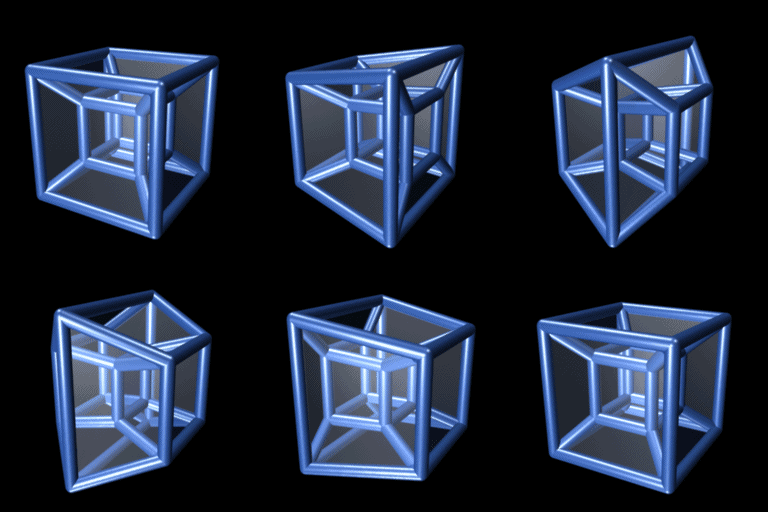
This is another thing where I can not get my head around. 3 spatial dimensions but with a 4th chucked in for good measure... all I still see with the visual examples of these are 2D visualisations of 3D cubes floating in and out of each other...to me just a fancy moving graphic which doesn't explain to me what is the 4th dimension of the hypercube.
The wikipedia page on '5th dimension' does a good job. http://en.wikipedia.org/wiki/Fifth_dimension
It's basically just a mathematical thing - an extra number to describe how curved space time is in the case of the 5th dimension.
It's basically just a mathematical thing - an extra number to describe how curved space time is in the case of the 5th dimension.
Understanding that a square is a 2D projection of a cube is the first step to understanding that a cube is a 3D projection of a hypercube. La Defense in Paris is a representation of a hypercube.
By definition it is difficult for us living in 3D to visualise more dimensions. However thinking about it mathematically is perfectly possible as long as you don't try to think about geometry.
By definition it is difficult for us living in 3D to visualise more dimensions. However thinking about it mathematically is perfectly possible as long as you don't try to think about geometry.
ewenm said:
By definition it is difficult for us living in 3D to visualise more dimensions. However thinking about it mathematically is perfectly possible as long as you don't try to think about geometry.
So is it correct to say that all the other dimensions are not spatial? ie. not x,y or z type dimensions.
(If not then what are they and why are they called 'dimensions'?)
Edited by AJI on Tuesday 6th October 15:16

AJI said:
Any maths/physics wizards on here that can give a good definition of what is a 'dimension' ?
I can easily understand the x,y,z dimensions and also 'time' as a dimension but can not get my head around any of the others.
Apparently there are about 11 altogether.
What can be a dimension if it is not a spatial x,y,z or 'time' ??
(don't ask me why I have asked this question...just one of those geeky things I'd like to understand)
Search YouTube for "Picturing the 10th dimension" and prepare to have your brain bleed...I can easily understand the x,y,z dimensions and also 'time' as a dimension but can not get my head around any of the others.
Apparently there are about 11 altogether.
What can be a dimension if it is not a spatial x,y,z or 'time' ??
(don't ask me why I have asked this question...just one of those geeky things I'd like to understand)
ewenm said:
Understanding that a square is a 2D projection of a cube is the first step to understanding that a cube is a 3D projection of a hypercube. La Defense in Paris is a representation of a hypercube.
By definition it is difficult for us living in 3D to visualise more dimensions. However thinking about it mathematically is perfectly possible as long as you don't try to think about geometry.
I find this a good explanation - http://en.wikipedia.org/wiki/Four-dimensional_spac...By definition it is difficult for us living in 3D to visualise more dimensions. However thinking about it mathematically is perfectly possible as long as you don't try to think about geometry.
And the tesseract is pretty cool

sonic_2k_uk said:
ewenm said:
Understanding that a square is a 2D projection of a cube is the first step to understanding that a cube is a 3D projection of a hypercube. La Defense in Paris is a representation of a hypercube.
By definition it is difficult for us living in 3D to visualise more dimensions. However thinking about it mathematically is perfectly possible as long as you don't try to think about geometry.
I find this a good explanation - http://en.wikipedia.org/wiki/Four-dimensional_spac...By definition it is difficult for us living in 3D to visualise more dimensions. However thinking about it mathematically is perfectly possible as long as you don't try to think about geometry.
And the tesseract is pretty cool
I have clicked on that wiki link and I'm still trying to understand the text.
The 4th dimension description under the "Orthogonality" heading is closest to the explainantion I am trying to get at.
BUT in effect it says, there is an x,y plane, a y,z plane and a x,z plane....this in effect makes up the space in which we live in...but apparently there is the 4th dimension which is perpendicular to all of these.....how? There are no more perpendiculars left from what I can make out.
You have x which is perpendicular to y which is perpendicular to z.... where can there be another perpendicular is my main question.
(I know if I look at it in pure maths whereby all I'm looking at are algebra and numbers on paper, I could probably start to follow it in that way, but I just can't visualise it....or am I not supposed to be able to?...in that case why do those moving images exist?)
My brain is now full of hurt.
AJI said:
You have x which is perpendicular to y which is perpendicular to z.... where can there be another perpendicular is my main question.
I have a BSc in Mathematics, but that's from years ago. I'm going to try to explain this using simplified language.2 Dimensions:
If you have a map you can plot coordinates as X and Y. This tells you how far to go along, and then how far up. You need a point to measure from and this is called the 'origin', aka (0,0). Cartesian Coordinates is a system for denoting points in space with respect to how far along and how far up the point is. For example, a point 3 along and 2 up from (0,0) is (3,2). This system is used for things like map references and the like.
3 Dimensions:
Hopefully it's fairly clear that you can define a point in "3D" by simply using a 3rd co-ordinate. The first two co-ordinates will define a point on the ground and the third tells you how far into the sky it will be. Points in this space are defined as (a,b,c) where a b c are just normal numbers (aka Real numbers). You can visualise this space by thinking of a 3D cube and points in the cube are referenced by the 3 coordinates. Because the coordinates are each real numbers this space is also known as "R3".
4 Dimensions:
Right, you can't really visualise 4 dimensions as our brains don't allow it. Best is to just think about extending the notation system explained above. This space is called "R4" and points are defined as (a,b,c,d) with a b c and d being real numbers. One way to try to visualise it is to think about a series of cubes in a line (like rubix cubes on a shelf). (a,b,c) will define a point in one cube, but d tells you which cube on the shelf to look at.
Higher Dimensions:
Again, just extend the notation. (a,b,c,d,e). Think about a row of rubix cubes sat on a shelf, then think about multiple shelves each with a row of cubes on. (a,b,c) tells you a point in a cube. d tells you which cube on a shelf and e tells you which shelf.
I personally find it impossible (or vv hard) to think about the geometry in more than one dimension, but it can be done using forulas. There is a formula for measuring the angle between two lines in 2D (you can meausre using a protractor). You can use a version of this formula to measure angles in 3D (again, you can tilt your protractor and still measure the angle). A further variant of the forumula allows you to calculate angles between lines in higher order spaces (like R4 and above).
I've talked about higher dimensions and the space in which hypercubes exist (cubes in R4 and above) as these are maths concepts. When people talk about time being a 4th dimension and the going on to talk about their being up to 11 dimensions which exist, these are Phsyics concepts. So they are different from talking about R4 and so on, which are Pure Maths concepts.
In terms of whether there really are 4 dimenesions, or 11 dimensions etc, you'll need to talk to a Physicist. Which I'm afraid I am not.
Edited by mrmr96 on Tuesday 6th October 16:39
djmck30 said:
AJI said:
Any maths/physics wizards on here that can give a good definition of what is a 'dimension' ?
I can easily understand the x,y,z dimensions and also 'time' as a dimension but can not get my head around any of the others.
Apparently there are about 11 altogether.
What can be a dimension if it is not a spatial x,y,z or 'time' ??
(don't ask me why I have asked this question...just one of those geeky things I'd like to understand)
Search YouTube for "Picturing the 10th dimension" and prepare to have your brain bleed...I can easily understand the x,y,z dimensions and also 'time' as a dimension but can not get my head around any of the others.
Apparently there are about 11 altogether.
What can be a dimension if it is not a spatial x,y,z or 'time' ??
(don't ask me why I have asked this question...just one of those geeky things I'd like to understand)

mrmr96 said:
AJI said:
You have x which is perpendicular to y which is perpendicular to z.... where can there be another perpendicular is my main question.
I have a BSc in Mathematics, but that's from years ago. I'm going to try to explain this using simplified language.2 Dimensions:
If you have a map you can plot coordinates as X and Y. This tells you how far to go along, and then how far up. You need a point to measure from and this is called the 'origin', aka (0,0). Cartesian Coordinates is a system for denoting points in space with respect to how far along and how far up the point is. For example, a point 3 along and 2 up from (0,0) is (3,2). This system is used for things like map references and the like.
3 Dimensions:
Hopefully it's fairly clear that you can define a point in "3D" by simply using a 3rd co-ordinate. The first two co-ordinates will define a point on the ground and the third tells you how far into the sky it will be. Points in this space are defined as (a,b,c) where a b c are just normal numbers (aka Real numbers). You can visualise this space by thinking of a 3D cube and points in the cube are referenced by the 3 coordinates. Because the coordinates are each real numbers this space is also known as "R3".
4 Dimensions:
Right, you can't really visualise 4 dimensions as our brains don't allow it. Best is to just think about extending the notation system explained above. This space is called "R4" and points are defined as (a,b,c,d) with a b c and d being real numbers. One way to try to visualise it is to think about a series of cubes in a line (like rubix cubes on a shelf). (a,b,c) will define a point in one cube, but d tells you which cube on the shelf to look at.
Higher Dimensions:
Again, just extend the notation. (a,b,c,d,e). Think about a row of rubix cubes sat on a shelf, then think about multiple shelves each with a row of cubes on. (a,b,c) tells you a point in a cube. d tells you which cube on a shelf and e tells you which shelf.
I personally find it impossible (or vv hard) to think about the geometry in more than one dimension, but it can be done using forulas. There is a formula for measuring the angle between two lines in 2D (you can meausre using a protractor). You can use a version of this formula to measure angles in 3D (again, you can tilt your protractor and still measure the angle). A further variant of the forumula allows you to calculate angles between lines in higher order spaces (like R4 and above).
I've talked about higher dimensions and the space in which hypercubes exist (cubes in R4 and above) as these are maths concepts. When people talk about time being a 4th dimension and the going on to talk about their being up to 11 dimensions which exist, these are Phsyics concepts. So they are different from talking about R4 and so on, which are Pure Maths concepts.
In terms of whether there really are 4 dimenesions, or 11 dimensions etc, you'll need to talk to a Physicist. Which I'm afraid I am not.
Edited by mrmr96 on Tuesday 6th October 16:39
I just kept looking at those wierd moving hypercube animations and just couldn't visualise how another perpendicular plane could exist. The human mind really can not visualise it in terms of showing it on 2D computer screen (well mine can't anyway).
I did used to be quite good at maths, 'a' grades at GCSE, 'a' grades at a-level and an engineering degree to boot...but never really delved into much of the 'more than 3 dimensions' maths.
Thanks to all for the replies.
Imagine an ant on the surface of a balloon. This is an animal moving in a 2d world. As far as it is concerned it can move forward, backwards, left or right. As it walks in the 2d world, it is also moving through 3d space. If you squeeze the balloon so it distorts then the rate it travels through 3d space changes. If you squeeze hard enough then the ant can teleport from one side of the balloon to the other with just a few steps.
You'll always struggle building a mental image of 4d space but you should be able to imagine how we can travel through 4d space without being aware of it. By manipulating the 4th dimension we should be able to jump through 3d space.
You'll always struggle building a mental image of 4d space but you should be able to imagine how we can travel through 4d space without being aware of it. By manipulating the 4th dimension we should be able to jump through 3d space.
Again, i find that wikipedia entry i linked to has a perfect explanation -
"Dimensional analogy was used by Edwin Abbott Abbott in the book Flatland, which narrates a story about a square that lives in a two-dimensional world, like the surface of a piece of paper. From the perspective of this square, a three-dimensional being has seemingly god-like powers, such as being able to remove objects from a safe without breaking it open (by moving them across the third dimension), being able to see everything that from the two-dimensional perspective is enclosed behind walls, and remaining completely invisible by standing a few inches away in the third dimension.
By applying dimensional analogy, one can infer that a four-dimensional being would be capable of similar feats from our three-dimensional perspective. Rudy Rucker illustrates this in his novel Spaceland, in which the protagonist encounters four-dimensional beings who demonstrate such powers."
"Dimensional analogy was used by Edwin Abbott Abbott in the book Flatland, which narrates a story about a square that lives in a two-dimensional world, like the surface of a piece of paper. From the perspective of this square, a three-dimensional being has seemingly god-like powers, such as being able to remove objects from a safe without breaking it open (by moving them across the third dimension), being able to see everything that from the two-dimensional perspective is enclosed behind walls, and remaining completely invisible by standing a few inches away in the third dimension.
By applying dimensional analogy, one can infer that a four-dimensional being would be capable of similar feats from our three-dimensional perspective. Rudy Rucker illustrates this in his novel Spaceland, in which the protagonist encounters four-dimensional beings who demonstrate such powers."
eldar said:
A neighbour of mine is a nuclear physicist. He once explained all 22 (or possibly 24) dimensions, I got confused after 3, but still ended up with bleeding ears.
A long time ago whilst watching Back To The Future on video with a friend who was studying Nuclear Physics, he started to explain how it might all be possible using dimensions etc. Suffice to say it was a student flat, we'd all had too much to drink and it made perfect sense... for a split second... 
sonic_2k_uk said:
Again, i find that wikipedia entry i linked to has a perfect explanation -
"Dimensional analogy was used by Edwin Abbott Abbott in the book Flatland, which narrates a story about a square that lives in a two-dimensional world, like the surface of a piece of paper. From the perspective of this square, a three-dimensional being has seemingly god-like powers, such as being able to remove objects from a safe without breaking it open (by moving them across the third dimension), being able to see everything that from the two-dimensional perspective is enclosed behind walls, and remaining completely invisible by standing a few inches away in the third dimension.
By applying dimensional analogy, one can infer that a four-dimensional being would be capable of similar feats from our three-dimensional perspective. Rudy Rucker illustrates this in his novel Spaceland, in which the protagonist encounters four-dimensional beings who demonstrate such powers."
Yes, I do find most of that makes perfect sense."Dimensional analogy was used by Edwin Abbott Abbott in the book Flatland, which narrates a story about a square that lives in a two-dimensional world, like the surface of a piece of paper. From the perspective of this square, a three-dimensional being has seemingly god-like powers, such as being able to remove objects from a safe without breaking it open (by moving them across the third dimension), being able to see everything that from the two-dimensional perspective is enclosed behind walls, and remaining completely invisible by standing a few inches away in the third dimension.
By applying dimensional analogy, one can infer that a four-dimensional being would be capable of similar feats from our three-dimensional perspective. Rudy Rucker illustrates this in his novel Spaceland, in which the protagonist encounters four-dimensional beings who demonstrate such powers."
I know that in a 1D world somebody looking at a 2D circle passing through it would see a point develop into a line which would grow to equal the length of the dieameter and then shrink again to a point.
Similarly living in a 2D world with a 3D sphere passing through it you'd see a point develop into a small diameter circle which would increase in size to equal the diameter of the sphere and it would then shrink back down to a point again.
But the next level is very difficult for me to visualise. What would a 4D 'sphere?' passing through a 3D world look like?
Or a 5D 'sphere?' passing through a 4D world?
My main difficulty is knowing what another dimension looks like in comparison to the 3D world we live in. I thought it must have been something obvious that I was missing because those animations of hypercubes seem to demonstrate something obvious...but I just can't get it.
But after the previous explaination about rubick's cubes on a shelf, it seems I am thinking about it totally wrong, and still need to visualise it in the 3D world but with a different 'slant'.
Gassing Station | The Lounge | Top of Page | What's New | My Stuff