
Cars To Drive Themselves By 2019
New research aims to loosen your grip on the steering wheel
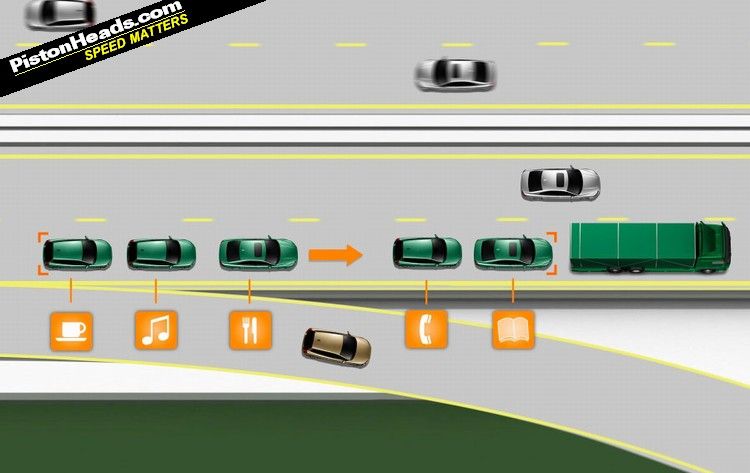
Would you trust your life to a trucker?
Project SARTRE (Safe Road Trains For The Environment) is being launched to develop and test technology for vehicles that can drive themselves in long road trains, potentially improving traffic flow and journey times, reducing accidents and reducing emissions. It is being led by Ricardo here in the UK, and the group also includes the Volvo Car Corporation.
SARTRE was officially inaugurated last month, and their new press release invites us to “imagine leaving home in the morning and, just after joining the motorway, meeting up with a number of other cars which inch up to each other, travelling at normal speed in a close-formation convoy. After a few minutes you can let go of the steering wheel and spend your time reading the morning paper, talking on the phone or watching the TV, while your car drives itself in complete safety and also saving fuel!”
The group’s researchers suggest that road trains can become reality within a decade:
“The first test cars equipped with this technology will roll on test tracks as early as 2011. The vehicles will be equipped with a navigation system and a transmitter/receiver unit that communicates with a lead vehicle. Since the system is built into the cars, there is no need to extend the infrastructure along the existing road network.
“The idea is that each road train or platoon will have a lead vehicle that drives exactly as normal, with full control of all the various functions. This lead vehicle is driven by an experienced driver who is thoroughly familiar with the route. For instance, the lead may be taken by a taxi, a bus or a truck. Each such road train will consist of six to eight vehicles.
“A driver approaching his destination takes over control of his own vehicle, leaves the convoy by exiting off to the side and then continues on his own to his destination. The other vehicles in the road train close the gap and continue on their way until the convoy splits up,” they reckon.
“I do appreciate that many people feel this sounds like Utopia, says Erik Coelingh, technical director of Active Safety Functions at Volvo Cars. However, this type of autonomous driving actually doesn’t require any hocus-pocus technology, and no investment in infrastructure. Instead, the emphasis is on development and on adapting technology that is already in existence. In addition, we must carry out comprehensive testing to verify our high demands on safety.”
Researchers see road trains primarily as a major benefit to commuters who cover long distances by motorway every day, but they will also be of potential benefit to trucks, buses, coaches vans and other commercial vehicle types.


2. What happenes for example when someone fits their car with rubbish tyres. The lead car emergancy stops and the car a few inches behind plows into it.
Idea is stupid and flawed, If I read one my "environment" plan/Initiative/lie I am going to scream!
Give up on trying to blame cars! the environment does what it does! FOR GODS SAKE cows give out more CO2 than cars every year.
I suppose it's gotta be better than using public transport?...
Example; everyone driving along and suddenly a child or animal runs out infront of the lead vehicle and is too close so an inevitable crash occurs. What happens to all the others behind them? Will they be programmed to avoid the accident infront of them? Do they stop (because 1 human will no doubt want to stop and help another)?
Sounds fairly straight forward when you think of "car trains", but in reality too much can happen that would end in total disaster. Think beyond just "on the road" type stuff - anything could happen. What about pot holes we avoid that would damage the car? Or a road sign / cone that has managed to get itself into the main road that you have to avoid.
Humans make mistakes, but our brains are extremely complex - more so than any computer of today (computers are only as good as the person that programmed them).
Just with automatic systems, public acceptance takes time. Its hard to beleive now, but when automatic lifts were introduced, they still had a lift operator on board because the public did not trust the system. Now, automatic systems are everywhere. The transition to autonomous systems will probably be very similar - just a lot quicker.
Still driving in Scotland's miles better than in the South once you get off the motorways!
It's certainly a better system than tailgating humans that take at least half a second to even register an emergency and then apply the brakes.
I wont be fitting it to my TVR though

If each car was independently controlled and maintained its separation by its own onboard computer/GPS alone then I could maybe see something like this happening, but to trust an 'expert driver' whom you have never met - well I wouldn't do it, would you? That sort of thing's only acceptable when there's no alternative (like being on a bus, train or plane etc).
And who's going to want to volunteer to be a dedicated 'experienced driver' - having 7 computer controlled tailgating idiots glued to your back bumper ?!?!?
On a more serious note, how much use would this be? I cant think of any journey i do where i'm on the motorway for more than say 40miles, even assuming your 'lead' vehicle stays on the whole time you do it's not gonna be long to read the paper.
There are many-many techincal and other hurdles to cross on this one, not least legal aspects- " Its wasnt me govnor.. it was the lead vehicle!"
Not going to be on a road near you any time soon- certainly not by 2012.. i doubt even 2019. Interesting research tho..
Gassing Station | Motoring News | Top of Page | What's New | My Stuff