
Couple of plane questions
Discussion


Can anyone tell me at what point a plane is deemed to be on 'final approach'when landing? is it when the plane lines up with the runway?,or when the landing gear is lowered? or maybe when it reaches a certain distance from the airport?
Also if a jet engined plane was parked on the ground with the engines ran at maximum reverse thrust and the brakes then released,would the plane travel along the ground backwards and if so potentially how fast?
Cheers
Also if a jet engined plane was parked on the ground with the engines ran at maximum reverse thrust and the brakes then released,would the plane travel along the ground backwards and if so potentially how fast?
Cheers
Edited by wildone63 on Wednesday 27th January 21:50
wildone63 said:
Can anyone tell me at what point a plane is deemed to be on 'final approach'when landing? is it when the plane lines up with the runway?,or when the landing gear is lowered? or maybe when it reaches a certain distance from the airport?
Also if a jet engined plane was parked on the ground with the engines ran at maximum reverse thrust and the brakes then released,would the plane travel along the ground backwards and if so potentially how fast?
Cheers
I beleive final approach is governed by distance rather than any thing else, certainly not landing gear.Also if a jet engined plane was parked on the ground with the engines ran at maximum reverse thrust and the brakes then released,would the plane travel along the ground backwards and if so potentially how fast?
Cheers
Edited by wildone63 on Wednesday 27th January 21:50
Aircraft would go backwards, but not very fast. There was a case of an aircraft at Heathrow (it was an Aeroflot one shortly after Russia had shot down an airliner "by mistake" and the ground crew would not touch it, the aircraft was "reversed" off the stand by use of reverse thrust. I heard it from home in Hounslow, some 4 or 5 miles away.
Depends on the approach pattern most of the time final approach is about one to two miles out, same with the landing gear it's down to the crew.
And as for the reverse thrust AA used to push back the MD80 with no tug
http://www.takeofftube.com/view/1430/aa-md-pushbac...
And as for the reverse thrust AA used to push back the MD80 with no tug
http://www.takeofftube.com/view/1430/aa-md-pushbac...
wildone63 said:
Can anyone tell me at what point a plane is deemed to be on 'final approach'when landing? is it when the plane lines up with the runway?,or when the landing gear is lowered? or maybe when it reaches a certain distance from the airport?
Also if a jet engined plane was parked on the ground with the engines ran at maximum reverse thrust and the brakes then released,would the plane travel along the ground backwards and if so potentially how fast?
Cheers
http://www.caa.co.uk/docs/33/CAP413.pdfAlso if a jet engined plane was parked on the ground with the engines ran at maximum reverse thrust and the brakes then released,would the plane travel along the ground backwards and if so potentially how fast?
Cheers
Edited by wildone63 on Wednesday 27th January 21:50
The definitive guide to when you should utter the word 'Final' on the radio in UK airspace.
You'll note there are over 100 references to the word in that document.
Generally, you could regard 'Final' approach as a phase of flight at which you have established a configuration, airspeed, height, rate-of-descent and flight-path to land and have the intention to do so, and that any runway incursion would be cause for an immediate go-around.
On controlled runways, calling 'Final' should be met by a confirmation of your clearance to land.
In an uncontrolled runway environment, hearing someone call 'Final' and proceeding to line-up is the height of bad manners.....as is calling 'Final' when you're in the next county - a habit of a certain class of spamcan drivers.
The classical square circuit diagram will have phases labelled 'Crosswind', 'Downwind', 'Base' and 'Final' - and if flown as often drawn, would have you pulling 6g at the corners. If you fly something with than a less-than favourable glide ratio, then the military-style oval circuit patterns make a lot more sense, but if the circuit is busy then obviously often you have to accommodate the lowest common denominator.
Personally, the 'Final' call in a retractable-gear type is accompanied by a call of '<n> greens', where <n> is the number of green gear indication lights / mechanical gear indicators you're expecting to see, and make bloody sure you're actually looking at the expected number of lights / indicators when you say it.
"Final approach" is a fairly vague term. The important instruction that the pilot needs from air traffic control is "Clear to land". This clearance can be given when the approaching plane is at varying differences to the end of the rrunway and is usually given when the runway has been vacated by all other aircraft.
Airliners tend to have a much longer, gentler approach to landing which begins quite a few miles out from the end of the runway.
Airliners tend to have a much longer, gentler approach to landing which begins quite a few miles out from the end of the runway.
eharding said:
Personally, the 'Final' call in a retractable-gear type is accompanied by a call of '<n> greens', where <n> is the number of green gear indication lights / mechanical gear indicators you're expecting to see, and make bloody sure you're actually looking at the expected number of lights / indicators when you say it.
I remember on one occasion having a student who called 'three greens, one in the mirror' on downwind, base and final despite there being only two green lights and nothing in the mirror! Fecking muppet! I've no idea if he's still flying but I sincerely hope not!In answer to the OP's question, I don't know what the proper definition is but 'Final Approach' to me would be after passing the Final Approach Fix/Point in a stable configuration for landing if on an instrument approach.
In a visual circuit I'd say it's when you turn from base to line up with the runway - so between 2 and four miles, 'short final' being less than a mile and a half and still not cleared. I seem to remember the FAA defined it as;
Long Final 4-8 miles
Final 2-4 miles
Short Final <2 miles
On an instrument approach (typical of airliners), the Final Approach Segment begins at the final approach fix (FAF)which is usually a beacon or waypoint, and goes until the more pertinent of either the Missed Approach Point, or touchdown.
Similarly, the intermediate approach segment is the section between the intermediate approach fix (IAF) and the FAF.
Visually, as eharding said, is when you're in a stabilized descent to the touchdown point, and technically, in the correct configuration, though certain aircraft will retain the landing flaps for closer to the touchdown.
In light aircraft flying a visual circuit, it pretty much means when they have turned from the base leg to finals. As such in the base-finals turn, controllers will refer to them as 'turning finals'.
Similarly, the intermediate approach segment is the section between the intermediate approach fix (IAF) and the FAF.
Visually, as eharding said, is when you're in a stabilized descent to the touchdown point, and technically, in the correct configuration, though certain aircraft will retain the landing flaps for closer to the touchdown.
In light aircraft flying a visual circuit, it pretty much means when they have turned from the base leg to finals. As such in the base-finals turn, controllers will refer to them as 'turning finals'.
wildone63 said:
Also if a jet engined plane was parked on the ground with the engines ran at maximum reverse thrust and the brakes then released,would the plane travel along the ground backwards and if so potentially how fast?
There's only one that I've seen do that and that's the C17, not sure if there are any other jets out there that can do it.Video here
http://www.youtube.com/watch?v=SGcshQZ9Mfg

I've seen a number of aircraft over the years reverse into parking slots - or reverse down a runway.
I've seen a Hercules do it.
I've seen a Globemaster II do it.
And I remember seeing an old Convair 340 piston engined airliner do it at Dublin Airport back in the 1970s. Most impressive.
I've seen a Hercules do it.
I've seen a Globemaster II do it.
And I remember seeing an old Convair 340 piston engined airliner do it at Dublin Airport back in the 1970s. Most impressive.
Eric Mc said:
I've seen a number of aircraft over the years reverse into parking slots - or reverse down a runway.
I've seen a Hercules do it.
I've seen a Globemaster II do it.
And I remember seeing an old Convair 340 piston engined airliner do it at Dublin Airport back in the 1970s. Most impressive.
I remember being at the Farnbourough airshow some years ago when the C17 was brand new, seeing it reverse down the runway in a heavy rainstorm, looked quite surreal as it was pulling a huge jet of water into each engine...I've seen a Hercules do it.
I've seen a Globemaster II do it.
And I remember seeing an old Convair 340 piston engined airliner do it at Dublin Airport back in the 1970s. Most impressive.
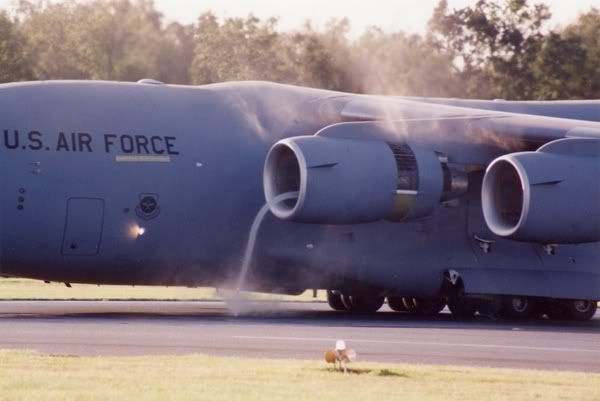
Edited by thatone1967 on Monday 1st February 12:38

 .
.Gassing Station | Boats, Planes & Trains | Top of Page | What's New | My Stuff