
Metals advice Please alloy v steel for gearbox adapter
Discussion


Lot of informed people on here so looking for some sensible advice please.
I need to have an adapter made to link the gearbox of my f3000 single seater racing car to its new engine.
The gearbox originally bolted up directly to the dfv v8 engine, this engine has now been replaced with a YB cosworth 4 cylinder motor which uses a different bolt pattern.
I need to have made a plate with the current gearbox pattern on one side and the new engines pattern on the other. This needs to be 46mm thick for flywheel etc to line up.
The rear end bolts onto the gearbox so essentially the whole back end will be held to the car via the adapter.
If I use steel, the adapter will weigh approx 36kg but if I use an aluminium alloy this reduces to approx 12.5kg so a significant saving.
My big worry with aluminium is that the holding bolts could tear out of the alloy but dont think it would be a problem with steel.
The dfv block is aluminium and the gearboxes magnesium case originally bolted into this no problem so am I being paranoid.
I am no metals expert and would like to hear some views. I plan to use it as a track car so it wont be competing.
Any suggestions as to suitable materials.
Also would any uk based engineers like to quote to make the plate.
This is the adapter drawing
I have now put together an accurate template for the gearbox adapter, pic below.

Its basically a sheet of steel 560mm x 345mm x 46mm thick
there would be a hole 260mm diameter in the centre for the flywheel, and offset from this a smaller hole for the nose of the starter motor. Around the starter motor hole the face would have to be recessed 28mm for the starter mounts to fit (hatched area)
To reduce the weight the outer 100mm either side would need to be reduced to 25mm thick so its still flush on the face shown, but cut back behind. (so that it looks like a squashed T from above) These outer wings will form the mounting points for the side bars I will have fabricated later to stiffen up the engine.
Also to reduce weight a few round and oblong holes would need cutting out from the sheet (shown shaded)
If the adapter was aluminium instead of steel I would probably not bother with the cut outs other than flywheel and starter holes
thanks
PAUL
I need to have an adapter made to link the gearbox of my f3000 single seater racing car to its new engine.
The gearbox originally bolted up directly to the dfv v8 engine, this engine has now been replaced with a YB cosworth 4 cylinder motor which uses a different bolt pattern.
I need to have made a plate with the current gearbox pattern on one side and the new engines pattern on the other. This needs to be 46mm thick for flywheel etc to line up.
The rear end bolts onto the gearbox so essentially the whole back end will be held to the car via the adapter.
If I use steel, the adapter will weigh approx 36kg but if I use an aluminium alloy this reduces to approx 12.5kg so a significant saving.
My big worry with aluminium is that the holding bolts could tear out of the alloy but dont think it would be a problem with steel.
The dfv block is aluminium and the gearboxes magnesium case originally bolted into this no problem so am I being paranoid.
I am no metals expert and would like to hear some views. I plan to use it as a track car so it wont be competing.
Any suggestions as to suitable materials.
Also would any uk based engineers like to quote to make the plate.
This is the adapter drawing
I have now put together an accurate template for the gearbox adapter, pic below.
Its basically a sheet of steel 560mm x 345mm x 46mm thick
there would be a hole 260mm diameter in the centre for the flywheel, and offset from this a smaller hole for the nose of the starter motor. Around the starter motor hole the face would have to be recessed 28mm for the starter mounts to fit (hatched area)
To reduce the weight the outer 100mm either side would need to be reduced to 25mm thick so its still flush on the face shown, but cut back behind. (so that it looks like a squashed T from above) These outer wings will form the mounting points for the side bars I will have fabricated later to stiffen up the engine.
Also to reduce weight a few round and oblong holes would need cutting out from the sheet (shown shaded)
If the adapter was aluminium instead of steel I would probably not bother with the cut outs other than flywheel and starter holes
thanks
PAUL
Edited by PAUL. S on Sunday 21st March 22:29
I had this adaptor made up in ally (not sure of the grade I'm afraid)
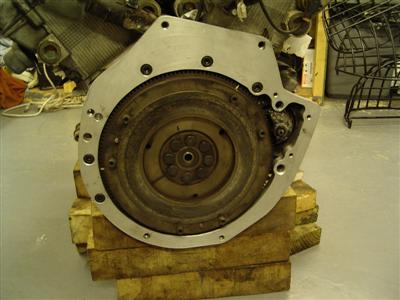
It's about 45mm thick. Not used it yet mind, but the guy who made it does this for a living so I'm assuming it'll be right
Screws directly into the ally, but then the gearbox casing is ally too so one would assume that it should be fine.
It's about 45mm thick. Not used it yet mind, but the guy who made it does this for a living so I'm assuming it'll be right
Screws directly into the ally, but then the gearbox casing is ally too so one would assume that it should be fine.
I'd use aluminium grade 6082T6. It's easily available and high strength, just don't weld anything to it as it ruins the strength. It is very similar in strength to regular mild steel at 240N/mm^2, the steel would be 275N/mm^2. Helicoil inserts would seem like a good way to go for the threads if you were concerned about pull out strength but I suspect it will not be a problem.
Keith.
Keith.
Paul, It depends on who does your plasma cutting, but generally you will find the cut surface of a plasma profile will be tapered up to 3 degrees but this can be better depending on the place doing the job. Also, holes of less that about 8mm diameter don't normally turn out too well. If you can afford it the water jet makes an all round better job, especially at that thickness. Any holes you require really tight accuracy for will still need to be machined, anything tighter than +/- 0.1mm.
If you did go for plasma, I don't think the heat affected zone would be very significant and in any case the material starts to recover over time (a few days), although the material in the HAZ never fully recovers without additional heat treatment.
If you did go for plasma, I don't think the heat affected zone would be very significant and in any case the material starts to recover over time (a few days), although the material in the HAZ never fully recovers without additional heat treatment.
Paul, It depends on who does your plasma cutting, but generally you will find the cut surface of a plasma profile will be tapered up to 3 degrees but this can be better depending on the place doing the job. Also, holes of less that about 8mm diameter don't normally turn out too well. If you can afford it the water jet makes an all round better job, especially at that thickness. Any holes you require really tight accuracy for will still need to be machined, anything tighter than +/- 0.1mm.
If you did go for plasma, I don't think the heat affected zone would be very significant and in any case the material starts to recover over time (a few days), although the material in the HAZ never fully recovers without additional heat treatment.
If you did go for plasma, I don't think the heat affected zone would be very significant and in any case the material starts to recover over time (a few days), although the material in the HAZ never fully recovers without additional heat treatment.
The Black Flash said:
I had this adaptor made up in ally (not sure of the grade I'm afraid)
It's about 45mm thick. Not used it yet mind, but the guy who made it does this for a living so I'm assuming it'll be right
Screws directly into the ally, but then the gearbox casing is ally too so one would assume that it should be fine.
Do you want to share his details, it might help others?It's about 45mm thick. Not used it yet mind, but the guy who made it does this for a living so I'm assuming it'll be right
Screws directly into the ally, but then the gearbox casing is ally too so one would assume that it should be fine.
Sure - it was Mick at A-Frame Engineering: http://www.aframeengineering.co.uk/.
I bought the plate online from here, prices compared well against local suppliers who would have to buy it in and cut it.
http://www.clickmetal.co.uk/Aluminium/Aluminium_Pl...
I will put a pic up once its been made
http://www.clickmetal.co.uk/Aluminium/Aluminium_Pl...
I will put a pic up once its been made
Gassing Station | Kit Cars | Top of Page | What's New | My Stuff