
rubbing down basecoat before clear coat?
Discussion


Just trying a quick touch up on my metallic blue MX5.
Have primed & flatted until I'm happy and have just applied the basecoat (aerosol).
Never used aerosol before and never metallic either. My only previous experience was about 15 yrs ago with compressor and proper spraygun and with cellulose. Much easier!
2 questions:
1 - what should the basecoat look like when applied - flat and dull or slightly shiney?
2 - should I continue with clear coat right now or do I wait 24 hours then flat the basecoat down 1st. I've read conflicting advice on the net.
Thanks all
Have primed & flatted until I'm happy and have just applied the basecoat (aerosol).
Never used aerosol before and never metallic either. My only previous experience was about 15 yrs ago with compressor and proper spraygun and with cellulose. Much easier!
2 questions:
1 - what should the basecoat look like when applied - flat and dull or slightly shiney?
2 - should I continue with clear coat right now or do I wait 24 hours then flat the basecoat down 1st. I've read conflicting advice on the net.
Thanks all
With metallic I find the best results are with it almost 'dusted' on. So not really a 'full' shiny basecoat effect as you'll end up with stripes in it which the clear laquer will make worse. Stand a little further back to get a larger (but lighter) spray pattern. Getting it even is the hard part which the 'dusting' method seem to help with. I did it this way with a full spray gun too and it seemed to work well as well as with cans.
Depending on ambient temperature you might be OK to apply clearcoat after a couple of hours wait. Remember that the longer the base coat is exposed then the more chance you have of getting it contaminated (assuming you're spraying outside or in a dusty garage rather than a pro spray booth). Also don't be tempted to rub the basecoat down before clearcoat as you'll spoil it and then seal in the mess with the clear for all to see.
I did a repair on a hire car once using cans and got away with it...and it was metallic black.
Depending on ambient temperature you might be OK to apply clearcoat after a couple of hours wait. Remember that the longer the base coat is exposed then the more chance you have of getting it contaminated (assuming you're spraying outside or in a dusty garage rather than a pro spray booth). Also don't be tempted to rub the basecoat down before clearcoat as you'll spoil it and then seal in the mess with the clear for all to see.
I did a repair on a hire car once using cans and got away with it...and it was metallic black.
Do dust coats as said above.When you are happy leave basecoat to dry for about an hour depending on ambient temperature.When dry,use a tack rag on the basecoat. One light wipe with a tack rag removes all particles of dust and fluff and leaves you with a clean surface for the laquer.....

Apply the coats at different angles too ("crossed coats"), to minimise striping. If you can, get one of those trigger-sprayers that allow you to hold the aerosol like a spraygun. Keep the aerosol warm to keep the pressure up as the amount of content in it drops. Keep the nozzle clean so it doesn't collect a drip and fire it into your work.
The coats want to be light, but still wet when they hit the panel. If the paint arrives on the panel as dust, it will have limited adhesion, and when the clearcoat goes on, the metallics can float into it, fall under gravity, and leave an obvious, mottled finish. Practice on your masking paper.
The tack rag should only remove environmental dust. If it comes away with paint colour on it, and metallic flakes from the paint, the colour has been applied too dry and dusty.
HTH
The coats want to be light, but still wet when they hit the panel. If the paint arrives on the panel as dust, it will have limited adhesion, and when the clearcoat goes on, the metallics can float into it, fall under gravity, and leave an obvious, mottled finish. Practice on your masking paper.
The tack rag should only remove environmental dust. If it comes away with paint colour on it, and metallic flakes from the paint, the colour has been applied too dry and dusty.
HTH
Do NOT use Tak duster/ cloth on the basecoat . If you've got an even "droplet" coat on the basecoat make sure your hands are clean and lightly wipe the surface to get rid of any dust, if you have an airline use it at the same time.
Tak dusters will leave lint on the surface which will then be trapped in the lacquer coat.
Tak dusters will leave lint on the surface which will then be trapped in the lacquer coat.
I am going to leap on this thread resurrection as it is very timely.
I painted a replacement bumper on my 02 Focus with rattle cans (metallic) a week or so ago. I simply applied the clear coat over the final 'dusted' base coat, 15 minutes later. It came out good enough for a car with an insurance value of £148
I've now halfway through the bonnet. I've applied the base coats (6!) but the surface was like sandpaper. I noticed on the can that it said it should be sanded before applying the clear coat. So I changed my plan, let it harden over night and flattened it back with 800 grit W&D. Reading this thread I am now in 2 minds whether to 'dust' it with another base coat or simply apply the clear coat.
What do you think?
I painted a replacement bumper on my 02 Focus with rattle cans (metallic) a week or so ago. I simply applied the clear coat over the final 'dusted' base coat, 15 minutes later. It came out good enough for a car with an insurance value of £148
I've now halfway through the bonnet. I've applied the base coats (6!) but the surface was like sandpaper. I noticed on the can that it said it should be sanded before applying the clear coat. So I changed my plan, let it harden over night and flattened it back with 800 grit W&D. Reading this thread I am now in 2 minds whether to 'dust' it with another base coat or simply apply the clear coat.
What do you think?
V8covin said:
NEVER flat the last coat of basecoat .
ThanksIn hindsight, the instructions on the can were ambiguous.
I am using metallic paint so I will put another coat of base on before I apply the clear coat.
Presumably, you can rub down non-metallic paint before applying the clear coat?
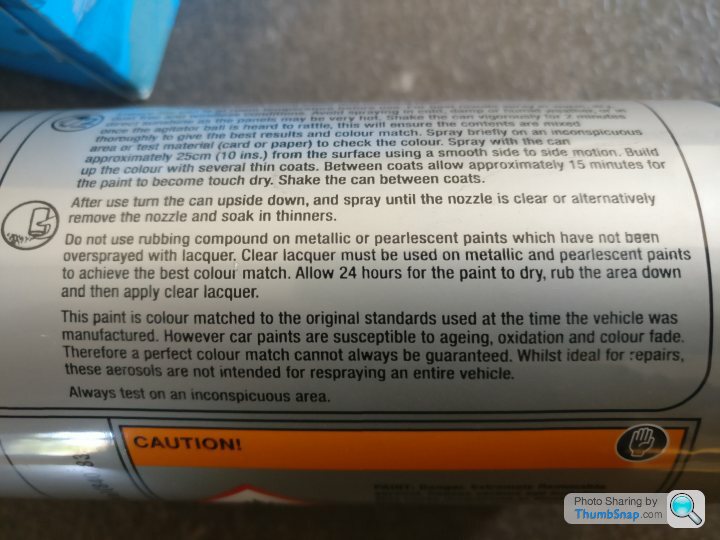 |https://thumbsnap.com/8GKKvDTP[/url]
V8covin said:
NEVER flat the last coat of basecoat .
Resurrecting this thread because this comment is only correct if you wait too long to apply the clear.If you wait longer than the flash time (about 15 mins) to apply the clear then you HAVE to sand the base coat to create a surface that the clear will adhere to properly.
People often think that whether their base coat looks shiny actually matters - IT DOES NOT. Only the final coat matters, which in this case will be the clear coat. Also don't use anything above 800 grit otherwise it will be too smooth and the clear won't adhere properly.
redrook said:
Resurrecting this thread because this comment is only correct if you wait too long to apply the clear.
If you wait longer than the flash time (about 15 mins) to apply the clear then you HAVE to sand the base coat to create a surface that the clear will adhere to properly.
People often think that whether their base coat looks shiny actually matters - IT DOES NOT. Only the final coat matters, which in this case will be the clear coat. Also don't use anything above 800 grit otherwise it will be too smooth and the clear won't adhere properly.
That is utter utter rubbish.If you wait longer than the flash time (about 15 mins) to apply the clear then you HAVE to sand the base coat to create a surface that the clear will adhere to properly.
People often think that whether their base coat looks shiny actually matters - IT DOES NOT. Only the final coat matters, which in this case will be the clear coat. Also don't use anything above 800 grit otherwise it will be too smooth and the clear won't adhere properly.
You can sand basecoat if you have any defects in it but you must spray another coat before clear coat.
You're getting confused between flash time and recoat window.
Flash time is the time between coats.
Recoat window means if you don't spray a further coat before a certain time you have to sand it.
With most solvent basecoats you have 24 hours to spray the clear before you have to sand it and then you must spray another coat of basecoat.
Gassing Station | Bodywork & Detailing | Top of Page | What's New | My Stuff