
How does the B2 Spirit work?
Discussion


I've just watched this video;
http://www.youtube.com/watch?v=IdbpMOWGYGk
Right, how does it not just spin round and round continuously?
Its not got a rear tail
http://www.youtube.com/watch?v=IdbpMOWGYGk
Right, how does it not just spin round and round continuously?
Its not got a rear tail
If you look at about 35s into the video you posted, you'll see the outer control surfaces open up like clamshells and act as drag rudders - they also act as flaps and ailerons too IIRC. The aircraft's fly-by-wire system continuously monitors, balances and adjusts the control surfaces to keep the aircraft flying.
Here's what happens when some of the sensors on the B-2 go on the blink:
http://www.youtube.com/watch?v=7psP_63RnyI
Here's what happens when some of the sensors on the B-2 go on the blink:
http://www.youtube.com/watch?v=7psP_63RnyI
Edited by Taffer on Wednesday 21st July 16:33
Jonny671 said:
Eric Mc said:
Flying wings are nothing new.
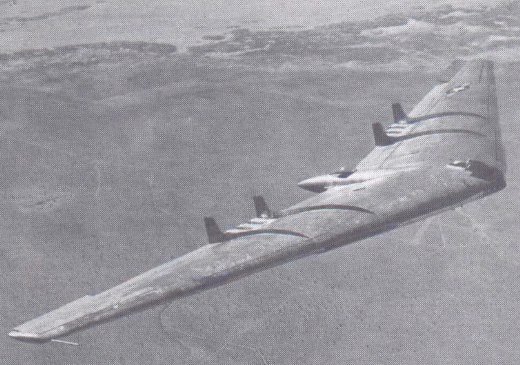
For some reason I've never watched any videos of them and obviously never seen one in real life before.Thanks for telling me how they work

Pitch stability is achieved by sweeping the wings back. Even before aerodynamicists discovered the advantage of sweepback when it came to transonic and supersonic flight, they knew that sweepback allowed for extreme centre of gravity shifts without the aircraft pitching up or down uncontrollably. That is why flying wings have definite sweepback - even if they are slow speed aircraft.
Yaw stability was more of a problem. Most early flying wings had some sort of fin system along the wing or on the wingtips to do the job normally carried out by the traditional tailfin and rudder. Before the advent of computer controlled fly by wire systems, yaw stability was qn issue and quite a few flying wing designs crashed because of this.
The B2, being computer controlled, can, in theory, sense when the aircraft is moving into an unstable regime and automatically correct the situation - even before the pilot is aware a problem is developing.
Here is a flying wing built by William Dunne from 1914 -

A Westland-Hill Pterodactyl from the early 1930s -

Another Westland-Hill tailless design -

A Horten flying wing glider from the 1930s

Edited by Eric Mc on Wednesday 21st July 18:58
Eric Mc said:
Flying wings are nothing new.
They go back to the Horten brothers: http://en.wikipedia.org/wiki/Horten_brothersSimpo Two said:
Eric Mc said:
Flying wings are nothing new.
They go back to the Horten brothers: http://en.wikipedia.org/wiki/Horten_brothers

Eric Mc said:
Simpo Two said:
Eric Mc said:
Flying wings are nothing new.
They go back to the Horten brothers: http://en.wikipedia.org/wiki/Horten_brothers

Simpo Two said:
There's no doubt Nazi Germany was ahead of its time. Now if they hadn't been trying to fight every country in the entire world all at once, what might they have achieved? First man on the moon possibly?
Very true.Just as the war finished the Americans instigated project "Paperclip" where they stole every bit of technology that they could get their hands on.
The Germans were willing to give every POTENTIAL development a fair amount of financial and technical suupport. The Allies were more conservative in that they primarilly funded the tried and tested designs rather than pfaff about with ideas which may or may not work.
I think the Allies were right.
I think the Allies were right.
Tango13 said:
Simpo Two said:
There's no doubt Nazi Germany was ahead of its time. Now if they hadn't been trying to fight every country in the entire world all at once, what might they have achieved? First man on the moon possibly?
Very true.Just as the war finished the Americans instigated project "Paperclip" where they stole every bit of technology that they could get their hands on.
Eric Mc said:
The Allies were more conservative in that they primarilly funded the tried and tested designs rather than pfaff about with ideas which may or may not work. I think the Allies were right.
In that situation yes, but of course if one only sticks to tried and tested things one never gets any further. Somebody had to light the first Saturn V...!Simpo Two said:
Eric Mc said:
The Allies were more conservative in that they primarilly funded the tried and tested designs rather than pfaff about with ideas which may or may not work. I think the Allies were right.
In that situation yes, but of course if one only sticks to tried and tested things one never gets any further. Somebody had to light the first Saturn V...!In 1939-45 there was a war to be one amd wasting time and effort on pie in the sky projects was not the best waqy to go about winning it.

Gassing Station | Boats, Planes & Trains | Top of Page | What's New | My Stuff