
Discussion


CelicaGT said:
Abrams, Leo 2A6, & Challenger 2 in no particular order. Each has strong points and weak points.
You'd have to include the latest Russian T-90M into that list, it also has explosive reactive armour like the Challenger 2 and it's the only one I've heard of with an on-board cryogenics system for use with (Thales made) thermal imaging equipment. Similar speed, armour, gun to the others.JamesNotJim said:
Leopard 2A7
Based on the yank abrams but with a longer barrel apparently. Was watching something this morning on sky about tank resto and where technology is heading and this new german Leopard 2A7 is now the worlds best tank.
hahaha, thats what prompted the question!Based on the yank abrams but with a longer barrel apparently. Was watching something this morning on sky about tank resto and where technology is heading and this new german Leopard 2A7 is now the worlds best tank.
an american programme that seemed to blowing smoke up the exhaust pipe of the Leopard struck me as...peculiar.
Cheers for all the responses!
FunkyNige said:
Crossflow Kid said:
Chally 2....rifled barrel. Abrams....not. 
Didn't they change the Challenger 2's barrel to be smooth bore to fire standard NATO ammo?CR2 or Abram probably vie for the top spot, but if my life depended on driving one i'd take a T-72 as there's half a chance I might be able to figure out the controls!
Cheers,
Rob
People were/are forever w king on about the Leopards being the best tanks of their generations. AFAIK (and off the top of my head so I await to be corrected) I don't think any have seen combat, so their 'greatness' is all on paper and has never really been tested. Whereas every post WW2 British tank from Centurion to Challenger 2 has and has performed well, and the same can be said for every American tank from M47 to Abrams.
As with any complex weapon system it rather depends on what you want it to do, and what was the philosophy behind it. The three traditional measures and characteristics of tanks are mobility, firepower and protection. The holy grail is to have all three, but until the advent of 1000-1500 bhp engines in a reasonable package, it just couldn't be done.
In WW2 most British and American tanks were under-gunned and under-armoured but had pretty good mobility. The experience of facing heavily gunned and armoured German tanks like the Tiger and Panther changed the British and US design philosphy which led to tanks which had great firepower and protection, but relatively poor mobilty - the British ones being worse in this respect. Funnily enough, the Germans, having lost aginst these allied tanks, came to the opposite conclusion and had developed the Leopard series which were fast and had big guns but poor protection. The French - who see themselves as dashing types - went even further in that direction, but they don't really count, as I could probably knock out an AMX-30 with a light dusting of colourful language.
The British tanks now have pretty good mobility, and stil have the best firepower and protection. US tanks are similar but are slightly more skewed in favour of mobility over protection. Same again for Leo 2, which has had to be contsantly up-armoured throughout its life, despite the constant claims to being the best.
Russian tanks probably came closest to achieving the best theoretical balance of firepower, mobility and protection, but in actual combat were nearly always bested by equivalent Western designs. Besides which, the way the tanks are handled, commanded and supplied all feeds into it. A properly organised force of inferior tanks should come out on top of badly organised and led force of better tanks, all other things being equal.
I've never been a tank crewman, nor would I want to be. But I have worked with them in some places and I can say that having a CR2 looking after you provides a warm feeling that a smaller vehicle like a Warrior just can't provide. Its silly, because there was no armour threat where I was at that time but it was certainly how I felt. I've also seen a CR2 shrug off an IED strike that would probably have disbled a Leopard and would have defeated a Warrior.
king on about the Leopards being the best tanks of their generations. AFAIK (and off the top of my head so I await to be corrected) I don't think any have seen combat, so their 'greatness' is all on paper and has never really been tested. Whereas every post WW2 British tank from Centurion to Challenger 2 has and has performed well, and the same can be said for every American tank from M47 to Abrams. As with any complex weapon system it rather depends on what you want it to do, and what was the philosophy behind it. The three traditional measures and characteristics of tanks are mobility, firepower and protection. The holy grail is to have all three, but until the advent of 1000-1500 bhp engines in a reasonable package, it just couldn't be done.
In WW2 most British and American tanks were under-gunned and under-armoured but had pretty good mobility. The experience of facing heavily gunned and armoured German tanks like the Tiger and Panther changed the British and US design philosphy which led to tanks which had great firepower and protection, but relatively poor mobilty - the British ones being worse in this respect. Funnily enough, the Germans, having lost aginst these allied tanks, came to the opposite conclusion and had developed the Leopard series which were fast and had big guns but poor protection. The French - who see themselves as dashing types - went even further in that direction, but they don't really count, as I could probably knock out an AMX-30 with a light dusting of colourful language.
The British tanks now have pretty good mobility, and stil have the best firepower and protection. US tanks are similar but are slightly more skewed in favour of mobility over protection. Same again for Leo 2, which has had to be contsantly up-armoured throughout its life, despite the constant claims to being the best.
Russian tanks probably came closest to achieving the best theoretical balance of firepower, mobility and protection, but in actual combat were nearly always bested by equivalent Western designs. Besides which, the way the tanks are handled, commanded and supplied all feeds into it. A properly organised force of inferior tanks should come out on top of badly organised and led force of better tanks, all other things being equal.
I've never been a tank crewman, nor would I want to be. But I have worked with them in some places and I can say that having a CR2 looking after you provides a warm feeling that a smaller vehicle like a Warrior just can't provide. Its silly, because there was no armour threat where I was at that time but it was certainly how I felt. I've also seen a CR2 shrug off an IED strike that would probably have disbled a Leopard and would have defeated a Warrior.

BruceV8 said:
In WW2 most British and American tanks were under-gunned and under-armoured but had pretty good mobility. The experience of facing heavily gunned and armoured German tanks like the Tiger and Panther changed the British and US design philosphy which led to tanks which had great firepower and protection, but relatively poor mobilty - the British ones being worse in this respect. Funnily enough, the Germans, having lost aginst these allied tanks, came to the opposite conclusion and had developed the Leopard series which were fast and had big guns but poor protection.
That's slightly unfair - from the A12 Matilda II onwards, British tanks have been generally good machines - they just tended to be handled very badly, and suffered from the Cruiser/Infantry split theory (with Infantry tanks being pressed into Cruiser roles, and vice-versa).The Centurion and Chieftain were highly mobile for what they were - indeed the Cent was ultimate expression of merging the Cruiser-Infantry theories together.
I think the Germans understood that it doesn't matter how good your armour is, or how big your gun, or how fast it'll climb cliffs; it's academic if you haven't got the fuel or spares to drive it, or if some sod is throwing 60lb rockets at you from up on high. The Chally/M1/T-90 designs of balanced packaging would be natural for those used to air-superiority, the Leopard the opposite.
I'd also suggest that where the British/American MBT concept is the natural conclusion of the Cruiser/Infantry tank theories, the Leopard is a development of the Sturmgeschutz/Jagdpanzer theory, if not design (the ultimate design being the bonkers Swedish Stridsvagen).
Anyway, back to the question - with modern tanks and their systems what they are today, the answer is (generally) whoever shoots first.
Simpo Two said:
Don't really care!

I'll see that and raise you this..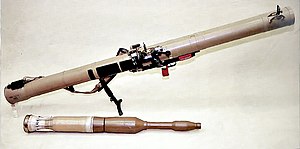
http://en.wikipedia.org/wiki/RPG-29
Edited by Mojocvh on Monday 20th September 18:33
Dunk76 said:
well informed stuff about tanks and that..
Yeah, but no, but yeah... You clearly know your stuff on this Dunk so I'll be careful here Dunk76 said:
That's slightly unfair - from the A12 Matilda II onwards, British tanks have been generally good machines - they just tended to be handled very badly, and suffered from the Cruiser/Infantry split theory (with Infantry tanks being pressed into Cruiser roles, and vice-versa)
I'm not sure I'd wholly agree. Matilda Mk II's good reputation was based on her heavy armour (even though its just a tank, Matilda still gets called a 'She'). The 2 Pr gun was as good as any anti-tank gun of its generation but suffered from having no useful HE round, AP shot being pretty useless against A/Tk guns. I'd say that the Crusader was the first decent British tank (its crews disliked it, but they had been used to the comparative comfort of the Sherman) with Comet being the first really good one. I do agree that the cruiser/infantry division was deeply flawed.Dunk76 said:
The Centurion and Chieftain were highly mobile for what they were - indeed the Cent was ultimate expression of merging the Cruiser-Infantry theories together.
The Cent was a marvellous tank, that I think disproved a lot of armoured warfare theories. But at 22 mph I'd hardly call it highly mobile. Chieftan was always underpowered and in its early days chronically unreliable. But, again, it was a great AFV. I see it as the spiritual successor of the Tiger.
Dunk76 said:
I think the Germans understood that it doesn't matter how good your armour is, or how big your gun, or how fast it'll climb cliffs; it's academic if you haven't got the fuel or spares to drive it, or if some sod is throwing 60lb rockets at you from up on high. The Chally/M1/T-90 designs of balanced packaging would be natural for those used to air-superiority, the Leopard the opposite.
Agreed.Dunk76 said:
I'd also suggest that where the British/American MBT concept is the natural conclusion of the Cruiser/Infantry tank theories, the Leopard is a development of the Sturmgeschutz/Jagdpanzer theory, if not design (the ultimate design being the bonkers Swedish Stridsvagen).
Interesting idea, which I hadn't really considered. I'll get right onto that, with thinking. I will say that postwar, the Germans did have their Jagdpanzer Kanone and Jagdpanzer Rakete which were an obvious update of the concept, in adition to their spangly new Leopard, so they must have foreseen different roles for the tank and the tank destroyer.Dunk76 said:
Anyway, back to the question - with modern tanks and their systems what they are today, the answer is (generally) whoever shoots first.
Yup 
Mojocvh said:
But I shall keep my feet dry and be home in time for tea and buns 
Gassing Station | Boats, Planes & Trains | Top of Page | What's New | My Stuff