
Fuel Tank and Fuel Swirl Pot
Discussion


Hi All
I know that this is a well trodden path but I am coming up to deciding what fuel delivery system to install and I can't make up my mind.
I don't understand why there is the complication of low pressure pumps and a swirl pot etc...
This is what I am planning, and would very muck like your comments....
Tank 1: feed to 80micron filter -> High Pressure Fuel Pump -> 8 micron filter -> T piece to injector rails, then a regulator then to Tank 2.
Between Tank 1 and Tank 2: a 3/4 pipe joining the two stuffed with fuel foam / anti surge foam and a metal gauze either side.
This means:
1. Both tanks will go down at the same time
2. Fuel filling can take place from either tank
3. The foam will prevent surge even on extended cornering (I will calculate fuel transfer rate to be high enough for filling, buy low enough to prevent surge)
4. Fuel will be as cool as possible as it is taken from tank 1 and returned to tank 2 - max possible heat sinking.
5. Because both tank are vented to atmosphere there does not have to be any air transfer plumbing.
Safe, low weight, low complexity, higher reliability, cooler fuel... simples ;-)
Down sides? erm, can't think of any! can you?
( or am I seriously missing something? )
Gareth
I know that this is a well trodden path but I am coming up to deciding what fuel delivery system to install and I can't make up my mind.
I don't understand why there is the complication of low pressure pumps and a swirl pot etc...
This is what I am planning, and would very muck like your comments....
Tank 1: feed to 80micron filter -> High Pressure Fuel Pump -> 8 micron filter -> T piece to injector rails, then a regulator then to Tank 2.
Between Tank 1 and Tank 2: a 3/4 pipe joining the two stuffed with fuel foam / anti surge foam and a metal gauze either side.
This means:
1. Both tanks will go down at the same time
2. Fuel filling can take place from either tank
3. The foam will prevent surge even on extended cornering (I will calculate fuel transfer rate to be high enough for filling, buy low enough to prevent surge)
4. Fuel will be as cool as possible as it is taken from tank 1 and returned to tank 2 - max possible heat sinking.
5. Because both tank are vented to atmosphere there does not have to be any air transfer plumbing.
Safe, low weight, low complexity, higher reliability, cooler fuel... simples ;-)
Down sides? erm, can't think of any! can you?
( or am I seriously missing something? )
Gareth
Its sounds fine....so long as your volume calcs work out....consumption at WOT might exceed gravity/G combined transfer rate when foam restricted.. even with a 3/4 balance pipe. All depending on your target power/end use/engine choice.
Flat out, 600-800 true Hp might only return 3-6 MPG or 20-40 seconds per gallon gravity-transfer rate worse case !
Flat out, 600-800 true Hp might only return 3-6 MPG or 20-40 seconds per gallon gravity-transfer rate worse case !
Only problem occurs when/if fuel pump sucks air/vapour such as under hard cornering with lowish fuel level. This will create a "slug" of air in the fuel system which has no escape but through an injector creating the possibility of momentary weak fuelling and the possibility of engine damage that this brings. In a carb system the air vents from the fuel bowl so no problem. Likelihood of occurrence slight potential damage massive.
Ideally there would be an in tank fuel pump that had baffles around the pickup for safety. The other option for me is to use two external fuel pumps that join to a single feed and have a check valve in each supply line.
This is what is on the car now.
Thanks for the photos of the air intake.
ken
This is what is on the car now.
Thanks for the photos of the air intake.
ken
As well high pressure (HP) fuel pumps don't really "suck" very well and they don't like air going through or rather no fuel as it will damage them.
You should have high volume low pressure (relatively speaking), ideally in the tanks, that feeds the HP pumps, ideally from a swirl pot then you always have a "head" of fuel and pressure.
The other thing I learned the other day is that it is best to feed pressure to both fuel rails at the same time and have the return at the other end. This way you have even pressure/flow on both rails. If you only have it coming in at one end and the return from the far end (like a loop) then you may get a slight pressure / flow drop by the time it gets “all the way around” which could create a lean condition on the last cylinders to be fuelled and therefore it could result engine damage.
I’m no expert but it probably best to use a tried and true method for your fuel system.
You should have high volume low pressure (relatively speaking), ideally in the tanks, that feeds the HP pumps, ideally from a swirl pot then you always have a "head" of fuel and pressure.
The other thing I learned the other day is that it is best to feed pressure to both fuel rails at the same time and have the return at the other end. This way you have even pressure/flow on both rails. If you only have it coming in at one end and the return from the far end (like a loop) then you may get a slight pressure / flow drop by the time it gets “all the way around” which could create a lean condition on the last cylinders to be fuelled and therefore it could result engine damage.
I’m no expert but it probably best to use a tried and true method for your fuel system.
GarethGTR said:
I don't understand why there is the complication of low pressure pumps and a swirl pot etc...
Call Richard or Ted at the factory, and they will explain to you why the LS7 works very well with a low pressure pump and a swirl pot feeding the high pressure pump (see picture)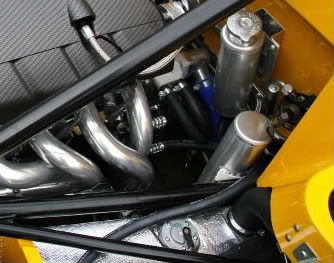
Swiss_Toni said:
I’m no expert but it probably best to use a tried and true method for your fuel system.
+1Save yourself the aggro - just go with the factory-tested set-up. The guy that bought my car drove it down to Monza and back in the hot weather, and he told me that it didn't miss a beat.
Regards
I think you are ok, I noticed that the factory connection link is returning a lot of fuel to the tank in use (in case of valves) about 30%.
I also noticed that you cannot really use the last 7 liters as the pump is already starting sucking air. I initially wanted to connect both tank but people warned me, today I would do exactly the same as you plan and use a larger pipe to connect the 2 tanks and simplify the system a lot. To prevent spillage I would install valves that allow air to go in but seal the opening against the fuel.
I also noticed that you cannot really use the last 7 liters as the pump is already starting sucking air. I initially wanted to connect both tank but people warned me, today I would do exactly the same as you plan and use a larger pipe to connect the 2 tanks and simplify the system a lot. To prevent spillage I would install valves that allow air to go in but seal the opening against the fuel.
my next built will have a single tank 50% bigger and on the passenger side as there is space available to the top and a baffle inside where I return the fuel and have the pump sitting and picking up.
This will make it possible to even go to the lowest levels. Will save me a lot of braided hoses, weight and money. I noticed that my FACET pump is already sucking air when I can fill in 32 liters so I already have 16 liters that I cannot really use. So my twin tank at the moment is 64 liters and with a 50% bigger single tank I can reach 60 liter, not much of a difference......and with an almost square tank I will have a much better accuracy on the fuel sender.
This will make it possible to even go to the lowest levels. Will save me a lot of braided hoses, weight and money. I noticed that my FACET pump is already sucking air when I can fill in 32 liters so I already have 16 liters that I cannot really use. So my twin tank at the moment is 64 liters and with a 50% bigger single tank I can reach 60 liter, not much of a difference......and with an almost square tank I will have a much better accuracy on the fuel sender.
Gareth: Your plan is a lot like what I have. I run a bigger cross feed line between the two tanks 1 inch. I used this bigger line to help equal the tanks when I am filling them. This worked out very well and the car will fill almost as quickly as a standard car maybe a bit slower on the last gallon or so.
I agree with Spatz out of the high pressure pump to a tee into both fuel rails to a fuel pressure regulator with the excess going back to the tank without the original feed pump.
I put my pump on a dropped plate next to the tank. this puts gravity induced flow at the inlet to the pump. Yes at the very bottom of the tank under max G loads you could perhaps grab some air but in 2 plus years its never happened. lee
I agree with Spatz out of the high pressure pump to a tee into both fuel rails to a fuel pressure regulator with the excess going back to the tank without the original feed pump.
I put my pump on a dropped plate next to the tank. this puts gravity induced flow at the inlet to the pump. Yes at the very bottom of the tank under max G loads you could perhaps grab some air but in 2 plus years its never happened. lee
How do racing cars like F1 solve this problem. I know they only have one tank but they need to extract the last of the fuel at the end of a race with much higher G forces than we see.
They must have found a light weight way of preventing air getting to the fuel injectors. Anybody know any tech guys in a race team to ask?
Paul
They must have found a light weight way of preventing air getting to the fuel injectors. Anybody know any tech guys in a race team to ask?
Paul
Hi
Thanks for all of the replies and info.
I have a monster fuel pump (FUELAB) which is AN10 in and out, so fuel delivery should not be a problem. As far as sucking air goes, when I get the tanks, I will see if there is a way to put a hard baffle in around the port, and if I can I will stuff this baffle with fuel foam or even better fuel felt. This will mean that even if there is air around this port, it will hold enough fuel for a few seconds running, and as soon as it comes into contact with fuel again it instantly soaks up more fuel. Some experimenting will be in order to get the balance right.
Hmmn! more research required, although I think I may be trying to fix a problem that is not even there! the normal foam should do this job just fine.
Gareth
Thanks for all of the replies and info.
I have a monster fuel pump (FUELAB) which is AN10 in and out, so fuel delivery should not be a problem. As far as sucking air goes, when I get the tanks, I will see if there is a way to put a hard baffle in around the port, and if I can I will stuff this baffle with fuel foam or even better fuel felt. This will mean that even if there is air around this port, it will hold enough fuel for a few seconds running, and as soon as it comes into contact with fuel again it instantly soaks up more fuel. Some experimenting will be in order to get the balance right.
Hmmn! more research required, although I think I may be trying to fix a problem that is not even there! the normal foam should do this job just fine.
Gareth
Storer said:
How do racing cars like F1 solve this problem. I know they only have one tank but they need to extract the last of the fuel at the end of a race with much higher G forces than we see.
They must have found a light weight way of preventing air getting to the fuel injectors. Anybody know any tech guys in a race team to ask?
Paul
I think they used to use double-skin pressurized bladder-type tanks Paul.....twas many moons ago when an F1 mechanic told me that though so things could have changed dramatically.They must have found a light weight way of preventing air getting to the fuel injectors. Anybody know any tech guys in a race team to ask?
Paul
The other big problem with our fuel system for injected cars (I don't know about carb versions) is the noise these pumps make. At low revs you can still hear the low pressure pump inside my car whilst driving!!!
Burying them in some fuel must help that but how to do it? I've got to have the tanks out as part of my rebuild over the winter so maybe some modifications to the tanks to give pickup point for a submersible pump for each tank. I don't know if this is possible or practical so will have to do some investigation.
I think fitting a bladder inside the tanks then pressurising the outer alloy tank to compress the bladder would probably be a step too far!!!! Would do away with the low pressure pump though.
Burying them in some fuel must help that but how to do it? I've got to have the tanks out as part of my rebuild over the winter so maybe some modifications to the tanks to give pickup point for a submersible pump for each tank. I don't know if this is possible or practical so will have to do some investigation.
I think fitting a bladder inside the tanks then pressurising the outer alloy tank to compress the bladder would probably be a step too far!!!! Would do away with the low pressure pump though.
Gassing Station | Ultima | Top of Page | What's New | My Stuff