
Suspension geometry, what are you running?
Discussion


You definitely want negative on a 5 - Google 'WIM fast road settings' or something similar and you will get an idea of what people are running.
Mine is .5 degrees front and 2 degrees rear, but I think it should be nearer 1 front and 1.5 rear.
For track I would start with 1.5 front and 2.5 rear and go from there.
Mine is .5 degrees front and 2 degrees rear, but I think it should be nearer 1 front and 1.5 rear.
For track I would start with 1.5 front and 2.5 rear and go from there.
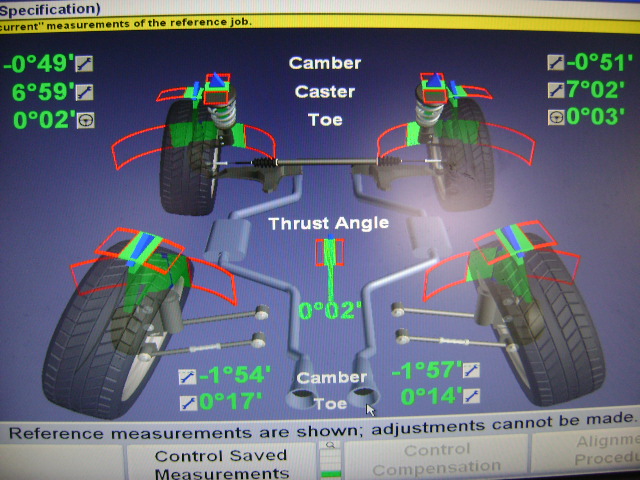


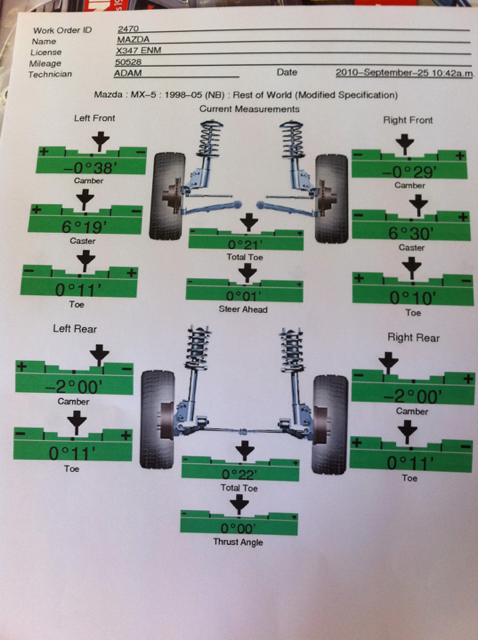
On my mk mk1 I have
F
camber -1
Toe 0.20
Castor L 4.88 R 5.27
R
Camber - 2
Toe 0.20
I corner weighted also-
FL 272kg FR 286kg
RL 244kg RR 238kg
Fr 53.7% Rr 46.3%
Front feels ace, darty but still stable on road, rear is ace for drifting but is a bit nervous road & track.
May just be worn bushes as it been drifted a fair bit, I'd like to try less rear camber but the bolts are shagged & need replacing for me to change & I feel the rear shcoks- p5 protechs need a rebuild also so may bea few factors- any thoughts anyone?
I found the following on nutz & else where- is just a cut & paste from various places may be useful
Fast road will not satisfy the avid track driver..... For this it's assumed the car has a very low COG, offering ground effect, tuned suspension, plenty of anti-roll and bracing, the Geometry calibration can be very aggressive and tyre wear not a consideration.
Example, and i mean example not law.....
MX5 MK1, stock suspension, no mods, average body height
Rear
Camber -1 degree 14'
Total Toe +18'
Front
Camber -32'
Castor +6 degrees 17'
Total Toe +12'
MX5 MK1, modified suspension, reasonable additional modifications, fast road
Rear
Camber -1 degree 30'
Total Toe +30'
Front
Camber -50'
Castor 6 degrees
Total toe +8'
MX5 MK1, track car, experienced driver
Rear
Camber -1 degree 30'
Total toe +40'
Front
Camber -2 degrees
Castor +4 degrees and over would be good
Total toe -30'
Icehawk settings:
camber -1.5degF / -2.0deg R
toe 1/16" out F / 1/16" in R
maxed caster
P5 settings-
Front
Just under 1 degrees -ve camber (55 minutes)
+1.6mm toe-in each side
~5.5 degrees castor
Rear
Just under 2 degrees -ve camber (1.50 minutes)
+0.3mm toe-in each side
FM settings
Front
Caster: 5.0 degrees
Camber: 1.0 degrees negative
Toe: 1/16" total (1/32" per side)
Rear
Camber: 1.5 degrees negative
Toe: 1/16" total (1/32" per side)
Lanny-
An alternative view
Here are my 1994 Miata's current alignment specs:
Rear
Toe: 1/32 inch (0°4.5' or 0.075°) IN per side
Camber: -1.75 degrees
Front
Camber: -1.2 degrees
Caster: 5.0 degrees
Toe: 1/32 inch IN per side
The parameters are listed in the order they should be set, starting with rear toe, which may constrain the other settings but is the single most important parameter for safe, predictable handling.
To get accurate results, the car must be aligned with the driver's seat ballasted with your weight (and your customary passenger's weight in the other seat, too, if that's how you normally drive for sport). Sitting in the car is one way to ballast, if the shop allows it. If you don't ballast, you won't get a precision alignment, since some values may change up to half a degree or 1/4 inch, depending on your weight.
These specs work for me, with my modest suspension mods, and have proven to be a good starting point for many Miata owners. However, every car is a little different, as are the needs of their drivers, so don't be afraid to experiment.
A history of my alignments
The first settings that worked well for me used camber of -1.0° front, -1.5° rear. The result was very lively, tending toward oversteer in fast sweepers and requiring a fair amount of attention to maintain a straight line on the highway - not darty, but sensitive to the smallest input. It was fun, but kept me busy.
Next time, I set the camber to -1.0° front, -1.75° rear. The car was calmer and a little less lively, exhibited less trailing-throttle oversteer, and didn't quite want to stay rotated under full throttle. In short, it understeered slightly. Some drivers will prefer such a 0.75° rear camber bias, which is easier to drive and requires less attention, but isn't as tossable.
I decided I didn't like any understeer at all, so I increased the front camber to -1.2°. The extra camber improved grip, and the balance is now quite neutral. Tire wear remains even across the tread, and the rears no longer wear twice as fast as the fronts. The car responds well to very-aggressive driving, yet remains forgiving, assuming I don't lift abruptly in a hard corner. A neutral Miata will oversteer on a trailing throttle!
Match the alignment to your needs
My personal alignment goals:
• neutral balance under constant power at speed, able to transition to oversteer with slight throttle lift to transfer weight forward
• a good match with my power steering, OEM springs, Koni shocks set full soft and top perch, FM swaybars set to soft front/medium rear, and 3-season performance tires (currently 195/50-15 Toyo T1R on 15x6.5 Slipstreams at 29 psi)
• enough negative camber to wear the tires evenly across the tread under my aggressive driving style
• good highway tracking without tramlining or dartiness
• good steering feedback
• street use, not autocross
These goals were met, although the car still tends to follow road camber by drifting very gently toward the shoulder if there's much crown. Your goals may differ, but keep these points in mind:
• Adding weight (passenger, luggage, whatever) makes the camber more negative, but not necessarily the way you might expect. Ballast for your intended usage, and exercise a little restraint under other conditions.
• If you drive hard in corners, more negative camber will actually help your tires last longer - regardless of what the dealer or the guy at Sears tells you - up to a point, say, -2.0 degrees for street use. If you don't ever drive hard, or if your tires start wearing on the inner shoulders, use less camber all around. Don't be afraid to experiment, once you understand these principles.
• Left and right sides must match. If a spec is unattainable on both sides, do the best you can then match the worse side.
• Maintain at least 0.5 degree front/rear camber bias. Larger bias = more understeer.
• 5 degrees of caster is enough for an NA; NBs can use up to 6. If you have manual steering, you may prefer less caster for easier low-speed turning.
• Sacrifice rear camber to get the correct rear toe.
• Sacrifice caster to get the correct front camber, maintaining the 0.5-0.75 degree F/R bias.
• You can set front toe in your driveway without upsetting any of the other parameters, if you wish to play with front toe out for lightning-quick turn-in for autocross. If it makes the car dart all over the highway, well...don't say I didn't warn you.
• Start with both swaybars set full soft, if you can (assuming yours are aftermarket bars). Use alignment to get the basic handling balance you want. If it's close but not quite there, then use swaybar adjustments to stiffen the end that "grips too much." (I started with my rear bar in the middle hole to preserve the endlink geometry.)
Where can you get a precision alignment?
Ideally, look for a shop that maintains road racing cars. A computerized rack is not necessary, but a skilled, creative mechanic is. He should start by asking your personal goals and your weight (or offer to let you sit in the car on the rack). If you get an argument instead, keep shopping. A good shop may charge you up to $150, or even more in difficult cases. This is reasonable for the rewards you'll get. Some Miatas are harder and take longer to align than others, and an honest shop is entitled to charge more for spending the extra time. You won't be sorry.
An alert technician may notice that the suspension bolts have become stretched after several alignment procedures, and want to sell you new ones. He's not ripping you off: they do stretch, new bolt/nut sets are cheap, and will help ensure that the alignment won't slip the next time you hit a pothole. The latest bolts last a lot longer, too.
What about my NB? What if my Miata is lowered and has 17-inch wheels? Why do my wheels look like / \?
According to reports from owners of 1999-and-later Miatas, these specs work just as well on the NB. A lowered Miata may have constraints on the minimum attainable camber, since lowering itself induces negative camber, but the above specs are still a good target; do the best you can. Wheel size has no effect. These specs will work on any NA or NB Miata. / \ is how they're supposed to look
F
camber -1
Toe 0.20
Castor L 4.88 R 5.27
R
Camber - 2
Toe 0.20
I corner weighted also-
FL 272kg FR 286kg
RL 244kg RR 238kg
Fr 53.7% Rr 46.3%
Front feels ace, darty but still stable on road, rear is ace for drifting but is a bit nervous road & track.
May just be worn bushes as it been drifted a fair bit, I'd like to try less rear camber but the bolts are shagged & need replacing for me to change & I feel the rear shcoks- p5 protechs need a rebuild also so may bea few factors- any thoughts anyone?
I found the following on nutz & else where- is just a cut & paste from various places may be useful
Fast road will not satisfy the avid track driver..... For this it's assumed the car has a very low COG, offering ground effect, tuned suspension, plenty of anti-roll and bracing, the Geometry calibration can be very aggressive and tyre wear not a consideration.
Example, and i mean example not law.....
MX5 MK1, stock suspension, no mods, average body height
Rear
Camber -1 degree 14'
Total Toe +18'
Front
Camber -32'
Castor +6 degrees 17'
Total Toe +12'
MX5 MK1, modified suspension, reasonable additional modifications, fast road
Rear
Camber -1 degree 30'
Total Toe +30'
Front
Camber -50'
Castor 6 degrees
Total toe +8'
MX5 MK1, track car, experienced driver
Rear
Camber -1 degree 30'
Total toe +40'
Front
Camber -2 degrees
Castor +4 degrees and over would be good
Total toe -30'
Icehawk settings:
camber -1.5degF / -2.0deg R
toe 1/16" out F / 1/16" in R
maxed caster
P5 settings-
Front
Just under 1 degrees -ve camber (55 minutes)
+1.6mm toe-in each side
~5.5 degrees castor
Rear
Just under 2 degrees -ve camber (1.50 minutes)
+0.3mm toe-in each side
FM settings
Front
Caster: 5.0 degrees
Camber: 1.0 degrees negative
Toe: 1/16" total (1/32" per side)
Rear
Camber: 1.5 degrees negative
Toe: 1/16" total (1/32" per side)
Lanny-
An alternative view
Here are my 1994 Miata's current alignment specs:
Rear
Toe: 1/32 inch (0°4.5' or 0.075°) IN per side
Camber: -1.75 degrees
Front
Camber: -1.2 degrees
Caster: 5.0 degrees
Toe: 1/32 inch IN per side
The parameters are listed in the order they should be set, starting with rear toe, which may constrain the other settings but is the single most important parameter for safe, predictable handling.
To get accurate results, the car must be aligned with the driver's seat ballasted with your weight (and your customary passenger's weight in the other seat, too, if that's how you normally drive for sport). Sitting in the car is one way to ballast, if the shop allows it. If you don't ballast, you won't get a precision alignment, since some values may change up to half a degree or 1/4 inch, depending on your weight.
These specs work for me, with my modest suspension mods, and have proven to be a good starting point for many Miata owners. However, every car is a little different, as are the needs of their drivers, so don't be afraid to experiment.
A history of my alignments
The first settings that worked well for me used camber of -1.0° front, -1.5° rear. The result was very lively, tending toward oversteer in fast sweepers and requiring a fair amount of attention to maintain a straight line on the highway - not darty, but sensitive to the smallest input. It was fun, but kept me busy.
Next time, I set the camber to -1.0° front, -1.75° rear. The car was calmer and a little less lively, exhibited less trailing-throttle oversteer, and didn't quite want to stay rotated under full throttle. In short, it understeered slightly. Some drivers will prefer such a 0.75° rear camber bias, which is easier to drive and requires less attention, but isn't as tossable.
I decided I didn't like any understeer at all, so I increased the front camber to -1.2°. The extra camber improved grip, and the balance is now quite neutral. Tire wear remains even across the tread, and the rears no longer wear twice as fast as the fronts. The car responds well to very-aggressive driving, yet remains forgiving, assuming I don't lift abruptly in a hard corner. A neutral Miata will oversteer on a trailing throttle!
Match the alignment to your needs
My personal alignment goals:
• neutral balance under constant power at speed, able to transition to oversteer with slight throttle lift to transfer weight forward
• a good match with my power steering, OEM springs, Koni shocks set full soft and top perch, FM swaybars set to soft front/medium rear, and 3-season performance tires (currently 195/50-15 Toyo T1R on 15x6.5 Slipstreams at 29 psi)
• enough negative camber to wear the tires evenly across the tread under my aggressive driving style
• good highway tracking without tramlining or dartiness
• good steering feedback
• street use, not autocross
These goals were met, although the car still tends to follow road camber by drifting very gently toward the shoulder if there's much crown. Your goals may differ, but keep these points in mind:
• Adding weight (passenger, luggage, whatever) makes the camber more negative, but not necessarily the way you might expect. Ballast for your intended usage, and exercise a little restraint under other conditions.
• If you drive hard in corners, more negative camber will actually help your tires last longer - regardless of what the dealer or the guy at Sears tells you - up to a point, say, -2.0 degrees for street use. If you don't ever drive hard, or if your tires start wearing on the inner shoulders, use less camber all around. Don't be afraid to experiment, once you understand these principles.
• Left and right sides must match. If a spec is unattainable on both sides, do the best you can then match the worse side.
• Maintain at least 0.5 degree front/rear camber bias. Larger bias = more understeer.
• 5 degrees of caster is enough for an NA; NBs can use up to 6. If you have manual steering, you may prefer less caster for easier low-speed turning.
• Sacrifice rear camber to get the correct rear toe.
• Sacrifice caster to get the correct front camber, maintaining the 0.5-0.75 degree F/R bias.
• You can set front toe in your driveway without upsetting any of the other parameters, if you wish to play with front toe out for lightning-quick turn-in for autocross. If it makes the car dart all over the highway, well...don't say I didn't warn you.
• Start with both swaybars set full soft, if you can (assuming yours are aftermarket bars). Use alignment to get the basic handling balance you want. If it's close but not quite there, then use swaybar adjustments to stiffen the end that "grips too much." (I started with my rear bar in the middle hole to preserve the endlink geometry.)
Where can you get a precision alignment?
Ideally, look for a shop that maintains road racing cars. A computerized rack is not necessary, but a skilled, creative mechanic is. He should start by asking your personal goals and your weight (or offer to let you sit in the car on the rack). If you get an argument instead, keep shopping. A good shop may charge you up to $150, or even more in difficult cases. This is reasonable for the rewards you'll get. Some Miatas are harder and take longer to align than others, and an honest shop is entitled to charge more for spending the extra time. You won't be sorry.
An alert technician may notice that the suspension bolts have become stretched after several alignment procedures, and want to sell you new ones. He's not ripping you off: they do stretch, new bolt/nut sets are cheap, and will help ensure that the alignment won't slip the next time you hit a pothole. The latest bolts last a lot longer, too.
What about my NB? What if my Miata is lowered and has 17-inch wheels? Why do my wheels look like / \?
According to reports from owners of 1999-and-later Miatas, these specs work just as well on the NB. A lowered Miata may have constraints on the minimum attainable camber, since lowering itself induces negative camber, but the above specs are still a good target; do the best you can. Wheel size has no effect. These specs will work on any NA or NB Miata. / \ is how they're supposed to look
I'm currently using (on Cusco adjustable suspension)-
Castor: 5.3° or thereabouts, I can't remember exactly.
Front Camber: -1.0°
Rear Camber: -1.5°
and very slight toe-in at both ends.
Previous car (on standard suspension) I had a bit pointier, from memory-
Castor: 5°
Front Camber: -1.2°
Rear Camber: -1.6°
with zero toe at both ends.
Castor: 5.3° or thereabouts, I can't remember exactly.
Front Camber: -1.0°
Rear Camber: -1.5°
and very slight toe-in at both ends.
Previous car (on standard suspension) I had a bit pointier, from memory-
Castor: 5°
Front Camber: -1.2°
Rear Camber: -1.6°
with zero toe at both ends.
Gassing Station | Mazda MX5/Roadster/Miata | Top of Page | What's New | My Stuff