
Wishbones, the longer the better?
Discussion


In general will a double unequal length wishbone system work better with longer wishbones? It seems to me that it would, as the radii would be longer and the geometry would therefore be better preserved as the suspension moves through its range. I expect there is more to it than that, though?
Difference in unsprung weight is fairly negligible, but the longer they are the stiffer they need to be, due to the length of our front lower wishbones they have a stiffener welded along the underside. Other than that I would say the longer the better (for the reasons you've already identified), obviously with the restrictions that the engine & chassis size dictate.
On a similar note, what happens if you use the same length wishbones top and bottom. If you have the KPI set out how you want it and adjustable by rose joints...what is the main reason for being unequal?
I would be able to build a much stronger space frame if I used a box looking front end.
(Hope this isnt a hijack mate)
I would be able to build a much stronger space frame if I used a box looking front end.
(Hope this isnt a hijack mate)
dmulally said:
On a similar note, what happens if you use the same length wishbones top and bottom. If you have the KPI set out how you want it and adjustable by rose joints...what is the main reason for being unequal?
I would be able to build a much stronger space frame if I used a box looking front end.
(Hope this isnt a hijack mate)
Unequal length wishbones, sometimes described as SLA (short, long arm) are used so that the wheel camber can be controlled better. This enables better camber recovery in roll.I would be able to build a much stronger space frame if I used a box looking front end.
(Hope this isnt a hijack mate)
Edited to add link to Mark Ortiz article:
http://www.auto-ware.com/ortiz/ChassisNewsletter--...
Edited by Paul Drawmer on Wednesday 2nd February 07:15
I would imagine that it depends on what suspension geometry you are trying to achieve.
Long wishbones will give the wheel a more linear movement but less camber change. F1 cars get away with this by having very little body roll and very little suspension movement.
The situation is complicated though by the ability to select the inner and outer wishbone pivot points as well as the wishbone length. The combination of the two fixes the virtual swing arm length and the roll centre.
Equal length wishbones will give very little camber compensation in roll.
Long wishbones will give the wheel a more linear movement but less camber change. F1 cars get away with this by having very little body roll and very little suspension movement.
The situation is complicated though by the ability to select the inner and outer wishbone pivot points as well as the wishbone length. The combination of the two fixes the virtual swing arm length and the roll centre.
Equal length wishbones will give very little camber compensation in roll.
Wishbone length generally ends up as a compramise, due to the requirements on a really car for the inner ends to miss things like large bits of powertrain etc, and the outer ends to miss things like the brake discs, wheels, and steering links etc. Generally, yes, the longer the better, but usually vehicle constraints get in the way of this:
In extreme circumstances, wishbones can be very long indeed:
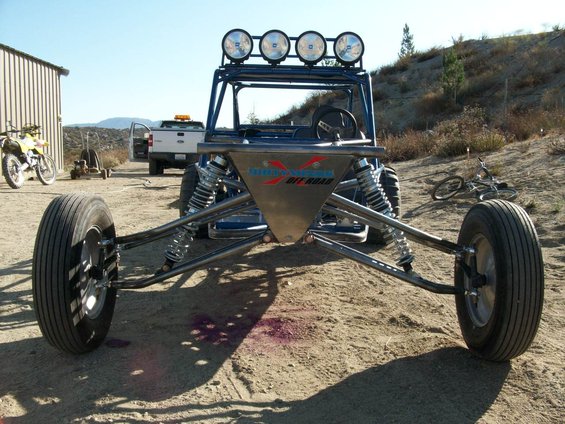
As with all things suspension, you can't look at any one factet in isolation, you must consider the system as a whole, and look at all the factors, before deciding on what compramises are acceptable (depending on your priorities and target attributes)
For a circuit racer, controlling the tyres Angle of attack in all planes (and chassis roll/pitch angles) is probably more important than maximising vertical wheel travel. On a road car, longitudinal compliance for ride comfort rears it's ugly head, and for a Baja off roader, 3 feet of travel to stop the wheels being ripped off by an unseen ditch is more important than wheel control on a loose surface. Compramise in the name of the game!
In extreme circumstances, wishbones can be very long indeed:
As with all things suspension, you can't look at any one factet in isolation, you must consider the system as a whole, and look at all the factors, before deciding on what compramises are acceptable (depending on your priorities and target attributes)
For a circuit racer, controlling the tyres Angle of attack in all planes (and chassis roll/pitch angles) is probably more important than maximising vertical wheel travel. On a road car, longitudinal compliance for ride comfort rears it's ugly head, and for a Baja off roader, 3 feet of travel to stop the wheels being ripped off by an unseen ditch is more important than wheel control on a loose surface. Compramise in the name of the game!
Edited by anonymous-user on Wednesday 2nd February 13:09
gtmdriver said:
The situation is complicated though by the ability to select the inner and outer wishbone pivot points as well as the wishbone length. The combination of the two fixes the virtual swing arm length and the roll centre.
It may be worth expanding on that by saying that whilst it fixes the static geometric roll centre and the static virtual swing-arm length, both of these can vary dynamically in response to suspension movement.IMO, control of dynamic roll centre movement is at least as important - possibly more important - than camber control, since it influences dynamic weight transfer.
Horses for courses realy, but for my car I tried to get them as long as I could without getting in the way.
But saying that Roll Centre control and camber gain are probably the most important factors to get right... Stable RC points at the right height was my first aim, and while playing with my cad model I noticed the difference in lenght between the top and bottom wishbones makes a massive difference to getting the RC point to stop moving under body roll...
One reason a car with very stiff suspension works better on a track is less movement in the suspension means less movement of the RC points, so a Car that might not have a very good sus design will work better with stiff springs. But a more stable RC point with a car that can still have some suspension movement and a little body roll, will handle just as good and will be way more comfortable and better over rougher surfaces....
Hope that makes sense..
But saying that Roll Centre control and camber gain are probably the most important factors to get right... Stable RC points at the right height was my first aim, and while playing with my cad model I noticed the difference in lenght between the top and bottom wishbones makes a massive difference to getting the RC point to stop moving under body roll...
One reason a car with very stiff suspension works better on a track is less movement in the suspension means less movement of the RC points, so a Car that might not have a very good sus design will work better with stiff springs. But a more stable RC point with a car that can still have some suspension movement and a little body roll, will handle just as good and will be way more comfortable and better over rougher surfaces....
Hope that makes sense..
Gassing Station | Kit Cars | Top of Page | What's New | My Stuff