
motion sensor PIR's and ballasts
Discussion


According to the product data sheet, you can only use it with electronic ballasts. Can you get any information off the ballasts, and a photo is possible and I'll tell you what you've got.
Out of interest, what are the room used for and what sort of size are they? Will the sensors have a clear view of the occupants?
Out of interest, what are the room used for and what sort of size are they? Will the sensors have a clear view of the occupants?
I'll have a look tomorrow. i wasn't sure whether i'd also need to fit passive ballasts. I know on the spec sheet that if used with multiple tubes then a ballast should be fitted but surely all tubes fittings come with there own ballasts fitted to control the incoming current so extra ones shouldn't be required. I'm trialing a couple in a kitchen area and a compressor room.
There will be some sort of control gear. You will have either:


- Switch start - this is easy to recognise as it has a starter switch
- Electronic ballast - white box of gubbings with mains in one side and output to the lamp on the other
- Reactive ballast - ugly great black box
Edited by Ganglandboss on Monday 11th April 00:52
Hummm...what's going on here?
OP - What is a passive ballast? Are you talking about adding a capacitor for power factor correction to a magnetic ballast? If that were required it should already be there regardless of having a motion sensor or not. Have you established what kind of control gear you have?
With respect, I think you should ask a spark to have a look. It's simple stuff really.
GLB - A switch starter is used with a magnetic ballast, so there aren't 3 types of ballast (for fluorescent lamps). 'Reactive' is just the yank name for magnetic. You're more likely to find one like this:

OP - What is a passive ballast? Are you talking about adding a capacitor for power factor correction to a magnetic ballast? If that were required it should already be there regardless of having a motion sensor or not. Have you established what kind of control gear you have?
With respect, I think you should ask a spark to have a look. It's simple stuff really.
GLB - A switch starter is used with a magnetic ballast, so there aren't 3 types of ballast (for fluorescent lamps). 'Reactive' is just the yank name for magnetic. You're more likely to find one like this:
VX Foxy said:
Hummm...what's going on here?
OP - What is a passive ballast? Are you talking about adding a capacitor for power factor correction to a magnetic ballast? If that were required it should already be there regardless of having a motion sensor or not. Have you established what kind of control gear you have?
With respect, I think you should ask a spark to have a look. It's simple stuff really.
GLB - A switch starter is used with a magnetic ballast, so there aren't 3 types of ballast (for fluorescent lamps). 'Reactive' is just the yank name for magnetic. You're more likely to find one like this:
That picture is a 'choke'. It is a simple coil which is used to generate a high striking voltage and limit the current. It is wired like this:OP - What is a passive ballast? Are you talking about adding a capacitor for power factor correction to a magnetic ballast? If that were required it should already be there regardless of having a motion sensor or not. Have you established what kind of control gear you have?
With respect, I think you should ask a spark to have a look. It's simple stuff really.
GLB - A switch starter is used with a magnetic ballast, so there aren't 3 types of ballast (for fluorescent lamps). 'Reactive' is just the yank name for magnetic. You're more likely to find one like this:

The starter switch is the most easily recognisable component and can usually be found without taking the cover off the luminaire.
A reactive ballast, or semi-resonant ballast, is a different beast. They are also an inductive device but have more connections plus a capacitor (although switch start luminaires often have a capacitor, it is for power factor correction and the lamp will strike without it). These are less common these days but there are still a few knocking about.
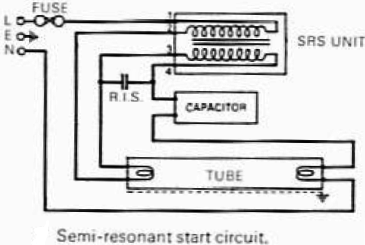
opted for some of these
http://uk.rs-online.com/web/search/searchBrowseAct...
fitted straight in without any hassles, only problem now is the boss wants them fitted everywhere!
http://uk.rs-online.com/web/search/searchBrowseAct...
fitted straight in without any hassles, only problem now is the boss wants them fitted everywhere!
Choke/ballast - same thing 
 You clearly know you your Henries from your Farads
Ganglandboss said:
A reactive ballast, or semi-resonant ballast, is a different beast... These are less common these days but there are still a few knocking about.
You must have been in this game a while! In 20 years I've never seen one! You clearly know you your Henries from your Farads VX Foxy said:
Choke/ballast - same thing
You clearly know you your Henries from your Farads
16 years! Ganglandboss said:
A reactive ballast, or semi-resonant ballast, is a different beast... These are less common these days but there are still a few knocking about.
You must have been in this game a while! In 20 years I've never seen one! You clearly know you your Henries from your Farads They were very common in commercial buildings. They have very good power factor and are easier on the lamp at start up than a switch start luminaire as there isn't a high striking voltage onto a cold lamp. They are more expensive than switch start fittings but this is offset by the better power factor and the longer lamp life. They have been superseded by electronic ballasts in most commercial applications.
I used to work at a university where they were tight as cramp when it came to maintenance of the buildings. There are buildings from the 1960s which still have substantial numbers of the original luminaires so I had to repair plenty of them.
Gassing Station | Homes, Gardens and DIY | Top of Page | What's New | My Stuff