
Daftest stuff said on PH which isn't really true
Discussion


cheesejunkie said:
Caddyshack said:
Yes, that is counter steering to keep the front end pointing in the intended direction of travel as per the term "counter steer" in a car but this perfectly highlights my example that counter steering on a motorbike is confused by its name as when using motorbike training parlance they mean counter steer to be pushing the bars in the desired direction of travel to make the bike turn. Therefore there are two meanings when discussing riding but one when driving a car.
Actually, if you are understeering in a car the best thing to do is unwind the lock to the straight ahead and wait for the tyres to do what they do best which is when they are pointed straight (also see slip angles)..so in theory you are then counter steering by not steering...untrained human nature is to keep applying more lock as the car isn't turning as much as you want but all you are doing is making things worse as the tyre loses efficiency the more it is turned from straight ahead. It was a magical feeling the first time I experienced unwinding the lock on the circles and wet handling circuits at MIRA.
All academic when you're sActually, if you are understeering in a car the best thing to do is unwind the lock to the straight ahead and wait for the tyres to do what they do best which is when they are pointed straight (also see slip angles)..so in theory you are then counter steering by not steering...untrained human nature is to keep applying more lock as the car isn't turning as much as you want but all you are doing is making things worse as the tyre loses efficiency the more it is turned from straight ahead. It was a magical feeling the first time I experienced unwinding the lock on the circles and wet handling circuits at MIRA.
 tting yourself. It's one thing knowing the theory it's another applying it in practice.
I've lost control of a vehicle on the open road twice. It's not an experience I want to repeat. First time was being young and dumb and showing off so my fault entirely and I've paid my dues and learned from it. Second was finding out a little too late that a council had saved a few quid by not gritting the motorway as I passed from one council area into the other. Squeaky bum time when the car decides to shimmy at 70 (honest guv it was 70) with other cars around you and passengers onboard who are not aware of how many beats your heart just skipped.
Could be worse. My wife found herself going backwards in the snow one day. I've been hit by drivers who don't know how to deal with loss of traction. It's all part of life. Road drivers are regularly running around with lethal weapons but thankfully very few end up with more pain beyond a large expense.
You are so right that the majority of motorists do run around in lethal weapons and when the conditions are bad they just do not realise how close to death they are and the people around them - it is as if they laws of physics do not apply - they think ABS will stop them in thick snow.
Caddyshack said:
GroundEffect said:
deadtom said:
Randy Winkman said:
julian64 said:
GroundEffect said:
That vehicle mass affects braking distances.
You will have to explain that as I'm totally thrown if that's not the case. It may not be the only factor, but surely its a factorLooking at static friction force of an object then:
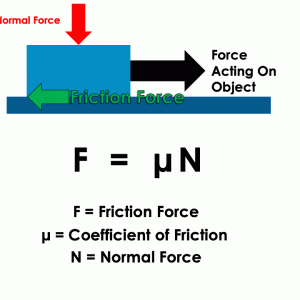
You'll see it is the normal force, not just mass that's affects how much grip you get. Assuming friction coefficient stays the same (same tyre compound, same tyre pressures) then we can increase braking effort potential by increasing the load on the tyre.*
I think everyone has at least heard of Weight Transfer, but this is the function of the force seen on a given axle change as acceleration is seen on the body. Under braking, more normal force is seen on the front tyres. Would that give us more braking capacity on the front axle? Yep! Why do you think front brakes are bigger than rears? They need to be able handle the higher duty cycle of the increased capability on the front axle.
So if we look at weight transfer:
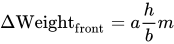
Vehicle mass is NOT a factor.
You can look at some examples:
From 60mph:
718 Cayman GT4: 30.5m (Motortrend)
Tesla Model S Plaid: 31.7m (Motortrend)
Tesla Model 3 Performance: 30.2m (Motortrend)
There is some difference in the result because of run to run differences, and not helped by the very low CoG of the Tesla, but they're basically the same despite 700kg more.
Or to reduce the mass a bit:
Alpine A110R: 33.1m (Sport Auto)
Lotus Elise 111R: 35.1m (Road & Track back in the day - older tyres)
Braking performance is more determined by the amount of weight transfer you can get. When I was designing Formula Student cars way back in the day, for the acceleration test it was all about maximising weight transfer, but rearward this time. Get the CoG height quite high and get the tyres as grippy as possible.
- These lead to another rabbit hole that larger brakes don't give you more braking power. They are there because they can handle more heat, therefore their performance is more stable over use. It's also semi-related to tyres too - wider tyres don't mean more grip; there is a relationship here unlike brakes but again it's not so obvious.
1) Larger brakes discs DO improve stopping power - the MAIN advantage is heat management but it is incorrect to say that they do not give more braking power. Simple physics show that A) the larger disc gives more leverage acting on the wheel. B) The larger swept area of the brake disc allows a larger pad to be used which means more heat can be produced (transfer of energy) at any time. C) Often larger discs are drilled to allow gases to escape - the larger disc allows more holes under the pad at any one time. D) the larger disc can handle more heat across the surface area (more energy transfer - not just the pad E) The Larger calipers can give a more even pressure over a larger area and also handle more heat.
Once down side is more mass to accelerate and decelerate due to the heavier disc plus needing bigger wheels etc...see unsprung weight.
2) Comparing a heavier car to a lighter car with a similar stopping distance is ignoring the facts that the manufacturers use brakes designed to the mass of the car - they all need to stop in roughly the same design window or we would all be running in the back of each other far more frequently - where the example above proves that it is nonsense to say "mass is not a factor" is when you then start to load up the cars with greater mass - i.e. the car full of rugby players - it is plainly obvious that the additional weight transfer will soon begin to lose against the greater mass...the Tesla above would soon increase the stopping distance once you add 500kg to it, then try 1000kg and then 2000kg - you will not need a top gear experiment to show you that the stopping distance will increase and if you do not believe me then sign a waiver and stand in front of me on a runway with varying weights in the same car.
3)Where a manufacturer runs out of engineering design or cost / design parameters or even laws you then get longer stopping distances - i.e. the lorries have specific weight limits when full - you have to subtract the wet weight of the vehicle from that, therefore a rigid lorry will have a longer stopping distance than the Elise or Tesla above as the mass is simply too great for the braking efficiency and therefore MASS HAS A HUGE IMPACT ON STOPPING DISTANCES - we have just become good at design to mask it with the varying masses of most production cars.
For:
1)
A) Leverage increase is only helpful if you have more grip capacity to utilise it - in almost all light duty scenarios that is not the case. So a "Yes but no" answer.
B) This is just false. Friction force of rigid bodies (not use elastomers or polymers like tyres here but brake pads and typical brake rotor materials are OK) is only linked from normal force and friction coefficient. This friction force is felt in the form of heat. If the force from the caliper is the same, you get no more heat. Your statement is incorrect.
C-E) All thermal management items
The primary purpose of bigger brakes on a road car is to give more consistent performance over repeated use, not to increase absolute brake performance.
2) I designed cars for 12 years but never got involved in chassis design (brakes, suspension, steering) but I can only imagine that brakes are sized for an expected minimum amount of repeated use for safety. Most likely scenarios of long downhill sections at GTM (Gross Train Mass). Your postulation isn't evidence btw. As Rizzo showed elsewhere, mass cancels out on both sides of the equation.
3) I'm not really sure your point
The force from a bigger caliper is (in most cases) greater though which produces more heat. The bigger caliper allows a larger piston or more pistons for better pressure across the pad, it is correct. The bigger pistons come with bigger masters to allow a greater pressure. As long as the car has enough friction it will stop quicker with bigger braking equipment - yes the primary benefit is heat with a bigger disc but it is wrong to say that it has no greater stopping power.
The mass does not cancel itself out in an absolute, you cannot just keep adding more mass and get the same braking distance as there is not an infinite friction co-efficient. Adding more weight to the same standard road car will increase the stopping distance very quickly. Do you seriously think that the same car with more weight in it will stop in the same distance?
Rizzo was only correct up to a point...(he) was correct that (and your colourful diagram) the normal force increases with mass BUT it needs to consider that the momentum increases by the same factor. Once you are braking at maximum braking ability the momentum will overcome the friction available and the sopping distance will increase. The brakes are also more likely to not be able achieve and sustain the same maximum braking force with the added mass due to heat management.
The mass does not cancel itself out in an absolute, you cannot just keep adding more mass and get the same braking distance as there is not an infinite friction co-efficient. Adding more weight to the same standard road car will increase the stopping distance very quickly. Do you seriously think that the same car with more weight in it will stop in the same distance?
Rizzo was only correct up to a point...(he) was correct that (and your colourful diagram) the normal force increases with mass BUT it needs to consider that the momentum increases by the same factor. Once you are braking at maximum braking ability the momentum will overcome the friction available and the sopping distance will increase. The brakes are also more likely to not be able achieve and sustain the same maximum braking force with the added mass due to heat management.
Edited by Caddyshack on Thursday 7th December 14:51
If the brakes are already capable of exceeding the grip of the tyres throughout the duration of a braking event, making them bigger won't improve the single stop braking performance. On a car which has no significant aerodynamic downforce and which already has good enough brakes to exceed the tyre grip, making it lighter won't shorten a single stop braking event either.
otolith said:
If the brakes are already capable of exceeding the grip of the tyres throughout the duration of a braking event, making them bigger won't improve the single stop braking performance. On a car which has no significant aerodynamic downforce and which already has good enough brakes to exceed the tyre grip, making it lighter won't shorten a single stop braking event either.
That is correctVery few braking systems will ever be able to exceed the grip of the tyres or maintain that. You won't get your ABS to trigger above 80mph much or when you have our 5 rugby mates and all their luggage in the car.
Caddyshack said:
The force from a bigger caliper is (in most cases) greater though which produces more heat. The bigger caliper allows a larger piston or more pistons for better pressure across the pad, it is correct. The bigger pistons come with bigger masters to allow a greater pressure. As long as the car has enough friction it will stop quicker with bigger braking equipment - yes the primary benefit is heat with a bigger disc but it is wrong to say that it has no greater stopping power.
The mass does not cancel itself out in an absolute, you cannot just keep adding more mass and get the same braking distance as there is not an infinite friction co-efficient. Adding more weight to the same standard road car will increase the stopping distance very quickly. Do you seriously think that the same car with more weight in it will stop in the same distance?
The bit in bold is the key thing here. The mass has no effect argument assumes that the maximum braking force is limited by the tyres grip not the brakes, It's an assumption, and I've certainly driven older cars where the limiting factor was the brakes not the tyres, but modern cars have much more powerful brakes. If the limit is the tyres grip then the bigger brakes don't have any greater stopping power as they can only provide as much force as the brakes can handle.The mass does not cancel itself out in an absolute, you cannot just keep adding more mass and get the same braking distance as there is not an infinite friction co-efficient. Adding more weight to the same standard road car will increase the stopping distance very quickly. Do you seriously think that the same car with more weight in it will stop in the same distance?
I would genuinely love to see a test of this because there are multiple other factors such as how close you can get to the tyre grip limit, what impact the increase contact patch has due to weight transfer, at what point you start to exceed the sheer strength of the tyre's compound, and of course at what point you exceed the maximum force the brakes can provide. However I'm sticking with "mass will make a lot less difference than you think it will" up to the cars gross vehicle weight.
Slight off topic, but with heat dissipation, energy varies with the square of the speed, so doubling the speed increases the amount of energy the brakes have to dissipate by a factor of 4, which is a good reason to fit bigger disks on higher performance cars.
RizzoTheRat said:
Caddyshack said:
The force from a bigger caliper is (in most cases) greater though which produces more heat. The bigger caliper allows a larger piston or more pistons for better pressure across the pad, it is correct. The bigger pistons come with bigger masters to allow a greater pressure. As long as the car has enough friction it will stop quicker with bigger braking equipment - yes the primary benefit is heat with a bigger disc but it is wrong to say that it has no greater stopping power.
The mass does not cancel itself out in an absolute, you cannot just keep adding more mass and get the same braking distance as there is not an infinite friction co-efficient. Adding more weight to the same standard road car will increase the stopping distance very quickly. Do you seriously think that the same car with more weight in it will stop in the same distance?
The bit in bold is the key thing here. The mass has no effect argument assumes that the maximum braking force is limited by the tyres grip not the brakes, It's an assumption, and I've certainly driven older cars where the limiting factor was the brakes not the tyres, but modern cars have much more powerful brakes. If the limit is the tyres grip then the bigger brakes don't have any greater stopping power as they can only provide as much force as the brakes can handle.The mass does not cancel itself out in an absolute, you cannot just keep adding more mass and get the same braking distance as there is not an infinite friction co-efficient. Adding more weight to the same standard road car will increase the stopping distance very quickly. Do you seriously think that the same car with more weight in it will stop in the same distance?
I would genuinely love to see a test of this because there are multiple other factors such as how close you can get to the tyre grip limit, what impact the increase contact patch has due to weight transfer, at what point you start to exceed the sheer strength of the tyre's compound, and of course at what point you exceed the maximum force the brakes can provide. However I'm sticking with "mass will make a lot less difference than you think it will" up to the cars gross vehicle weight.
Slight off topic, but with heat dissipation, energy varies with the square of the speed, so doubling the speed increases the amount of energy the brakes have to dissipate by a factor of 4, which is a good reason to fit bigger disks on higher performance cars.
The statement "mass makes a lot less difference" though needs to be further examined as Momentum needs to be considered.
This may help:
To summarise, the previous statement that Mass has no affect on braking distance is incorrect as momentum has not been considered. The lower level GCSE physics taught that the normal friction increases with the mass but it did not take momentum in to account at that level.
Do you think that the braking distance for the car would be exactly the same for single occupant to 5 up and all luggage as long as the gross vehicle weight? It won't. It probably could be at some low speeds as the brakes and tyres are good enough.
If you do think the stopping distance would be the same up to the gross vehicle weight then let's stick with that and explore why you think it would then increase once over the gross vehicle weight as the answer is due to the fact that MASS has a big impact on the stopping distance of the car.
The experiment has already been done by VW - I am trying to find the video - the braking was 33% longer with the greater mass.
Ford also did the experiment - hopefully I am allowed to post this link, it includes a video:
https://tfltruck.com/2015/05/2015-ford-expedition-...
https://tfltruck.com/2015/05/2015-ford-expedition-...
How does the 2015 Ford Expedition EL 4×4 perform at the 60-0 mph brake test empty and loaded? Weight matters in all aspects of vehicle dynamics: acceleration, handling and stopping. The long wheelbase Expedition EL is not a light weight. It is related to the F-150 frame and chassis, but it does not use an all aluminum body construction. It’s a large SUV with ample room for eight adults. The base curb weight of this truck is 6,100 lbs.
You can watch how it did with the 0-60 mph acceleration empty and loaded.
Now, how does it stop? The big Expedition stopped from 60 mph in 136.94 feet with only the driver. Two people in the cabin pushed the stopping distance to 140.80 feet. And four people increased the stopping distance to 147.42 feet. Each stopping run was performed in the same direction and with around 2 to 3 minutes between each run to allow the brakes to cool slightly.
You can watch how it did with the 0-60 mph acceleration empty and loaded.
Now, how does it stop? The big Expedition stopped from 60 mph in 136.94 feet with only the driver. Two people in the cabin pushed the stopping distance to 140.80 feet. And four people increased the stopping distance to 147.42 feet. Each stopping run was performed in the same direction and with around 2 to 3 minutes between each run to allow the brakes to cool slightly.
Caddyshack said:
To summarise, the previous statement that Mass has no affect on braking distance is incorrect as momentum has not been considered. The lower level GCSE physics taught that the normal friction increases with the mass but it did not take momentum in to account at that level.
I think momentum's irrelevant, as per the previous math's with the mas cancelling out. Kinetic energy (1/2 m v^2) is important though as that's the heat the brakes have to dissapate. Caddyshack said:
Now, how does it stop? The big Expedition stopped from 60 mph in 136.94 feet with only the driver. Two people in the cabin pushed the stopping distance to 140.80 feet. And four people increased the stopping distance to 147.42 feet. Each stopping run was performed in the same direction and with around 2 to 3 minutes between each run to allow the brakes to cool slightly.
Assuming 75kg per person that's about an 8% increase in mass resulting in an 8% increase braking distance. Exactly what you'd expect if the braking force was the same both times (distance = velocity^2 x mass / force), ie limited by the maximum force the brakes can generate rather than the tyres grip.ie the brakes on a 2015 Ford expedition are a bit s
t. 
For comparison, a 911 GT2 will apparently stop from 60 mph in 87 feet
Edited by RizzoTheRat on Thursday 7th December 16:01
otolith said:
Calculations based on momentum should give the same result as calculations based on energy, Newtonian mechanics is internally consistent.
Yes. The momentum increases in direct proportion to the increase in mass. This is exactly why the full car takes longer to stop than the empty car.RizzoTheRat said:
Caddyshack said:
To summarise, the previous statement that Mass has no affect on braking distance is incorrect as momentum has not been considered. The lower level GCSE physics taught that the normal friction increases with the mass but it did not take momentum in to account at that level.
I think momentum's irrelevant, as per the previous math's with the mas cancelling out. Kinetic energy (1/2 m v^2) is important though as that's the heat the brakes have to dissapate. Caddyshack said:
Now, how does it stop? The big Expedition stopped from 60 mph in 136.94 feet with only the driver. Two people in the cabin pushed the stopping distance to 140.80 feet. And four people increased the stopping distance to 147.42 feet. Each stopping run was performed in the same direction and with around 2 to 3 minutes between each run to allow the brakes to cool slightly.
Assuming 75kg per person that's about an 8% increase in mass resulting in an 8% increase braking distance. Exactly what you'd expect if the braking force was the same both times (distance = velocity^2 x mass / force), ie limited by the maximum force the brakes can generate rather than the tyres grip.ie the brakes on a 2015 Ford expedition are a bit s
t. For comparison, a 911 GT2 will apparently stop from 60 mph in 87 feet
Edited by RizzoTheRat on Thursday 7th December 16:01
GT3 will still stop quicker with one person that it will if you fill it with loads of weight.
Forget the brakes being good or bad on the test, it proves the braking distance increases with mass (due to momentum increasing in proportion to the mass)
otolith said:
Probably easier to make your point if you write out the equations?
You are right.The most famous one ever has it E=mc2 E is the total energy if we are talking about the relation of momentum to kinetic energy.
Ignore that though, it’s too deep….but for these purposes p= m v. momentum (p) mass (m) velocity (v)
Mass and velocity are both directly proportional to the momentum. If you increase either mass or velocity, the momentum of the object increases proportionally. If you double the mass or velocity you double the momentum.
If anyone wants to argue that the above is not true then they need to argue with Newton and not me.
A very simple home scientific test that he can do, right now. Go to the kitchen and place any box next to the fridge….push the box and notice how much shove it takes to get moving then do the same to the fridge. It takes much more shove to get the fridge moving - What this shows is the mass of the fridge takes more of a shove to overcome the mass than the small box…the unbreakable law of physics is that momentum increases directly in proportion to mass….
the video that he wanted shows the exact same car with the only variable being the weight of the occupants leading to longer stopping distances. It’s irrelevant what the condition of the brakes are as the only changing variable is the mass.
It is proven in physics and in the video.
Edited by Caddyshack on Thursday 7th December 19:25
roadsmash said:
Surely the OP is trolling.
I thought so but groundeffect then went on to try and back up the claim that mass has no effect on braking distance with pictures and writing equations. I think groundeffect really wanted to say that heavy road cars stop in about the same distance as light road cars…they do…but didn’t accept or maybe just explain that each of those cars will take longer to stop when you increase their mass.Whizzo, is correct up to a point that the increased mass does increase the friction coefficient but hasn’t got that the momentum also increases in proportion.
It does feel like trolling when the claim is that a fully loaded car will stop in the same distance as a single occupant car though and even when the physics and the requested test on video are provided.
Gassing Station | The Lounge | Top of Page | What's New | My Stuff