
Burnt out plug / socket advice
Discussion


Amused by the number of people saying "Don't use an extension" when first page of this thread shows that regular sockets can have exactly the same problem.
Poor connection between plug and socket is the issue. Resistance x current^2 = Heat. Nothing appears to have been overloaded, so if extension plug and socket were in good condition and met the quoted specs there shouldn't have been a problem.
Removing the extension lead halves the number of potentially dodgy connections (assuming the house wiring is all good). It's well worth doing, but not the actual "cause" of the problem.
Poor connection between plug and socket is the issue. Resistance x current^2 = Heat. Nothing appears to have been overloaded, so if extension plug and socket were in good condition and met the quoted specs there shouldn't have been a problem.
Removing the extension lead halves the number of potentially dodgy connections (assuming the house wiring is all good). It's well worth doing, but not the actual "cause" of the problem.
Mr Pointy said:
AnotherWorld said:
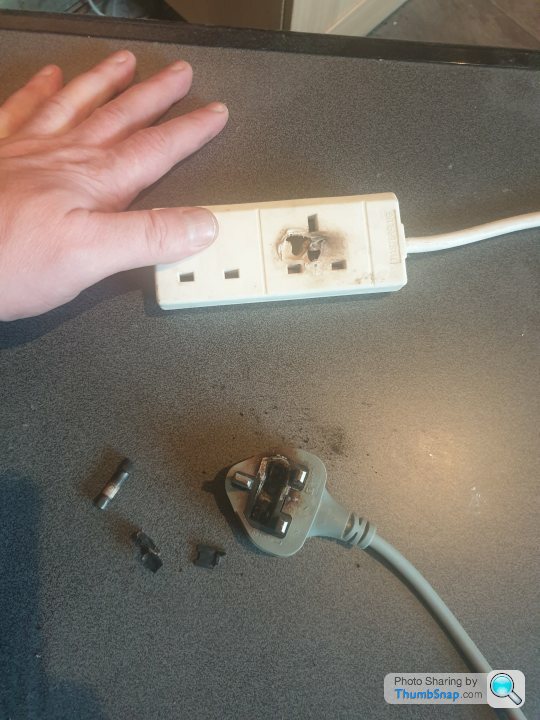
I saw this post and just wanted some advice if looking at the above images looked similar to the OP in such that it would be safe to put a new plug on and use a new extension on this drier.
I had a 13amp extension cord connected to the plug and came in to find it the way you see in the images, so obviously I wanted to know what the chance of tis happening again if I just cut the fitted plug of and replaced it with another plug and 13amp fuse and got a brand new extension to connect it, or wether this looks like something else could have caused the damage.
https://www.electricalsafetyfirst.org.uk/guidance/...
as example lets use your13amp two socket extension lead .....thats 13 amps for the entire extension lead not each individual socket
if you plug in a tumble dryer typically 2300w drawing around 11 amps

that only gives you 2 amps to use on the other socket before exceeding the rating for the extension lead
lets say you plug in a hairdryer in the other socket typically 2250w drawing around 10 amps

that would give a combined total of 21 amps if you had both items on at the same time

remember you are connecting an extension cable into a wall socket ,typically on a ‘ring main’ which is fed from a 32A breaker or fuse . you can see the extension lead is the weakest link and will over heat you are relying on the 13 amp fuse to fail
DBSV8 said:
as posted easy to overload a 13 amp extension ,
https://www.electricalsafetyfirst.org.uk/guidance/...
Yes, but that's not what's happened here. It's also possible to overload a ring main without resorting to extension leads. https://www.electricalsafetyfirst.org.uk/guidance/...
silentbrown said:
DBSV8 said:
as posted easy to overload a 13 amp extension ,
https://www.electricalsafetyfirst.org.uk/guidance/...
Yes, but that's not what's happened here. It's also possible to overload a ring main without resorting to extension leads. https://www.electricalsafetyfirst.org.uk/guidance/...

edit yes hence the link to overloading circuits helps visualise how much power items like kettles , microwaves draw compared to fridges etc
Edited by DBSV8 on Friday 3rd February 20:08


Thanks. We’ve got the electrician coming Saturday who will quite possibly sort everything as the drier was still going despite the burning plug, so we’re hoping that it still works and the plug being redone properly will remedy everything. We’re also asking her to look at the wiring as best she can to check it’s not a house issue but from reading what’s here it seems most likely to be the appliance.
Seems to happen more than you’d think. Mind you this was a new build.
The circuit breaker tripped occasionally then tripped altogether and wouldn’t go back on. By a process of elimination we narrowed it down to the washing machine.
The electrician reckons it was just a loose connection but checked the rest of the installation as much as he could anyway.
Gassing Station | Homes, Gardens and DIY | Top of Page | What's New | My Stuff