
Question about Dry Graded wood - help!
Discussion


During the summer, I began renovation of my porch, and due to various issues it wasn't completed.
I have some exposed timber, and my question is - how long can I leave this exposed to the elements?
The wood is marked: EN 14081 "Dry Graded C24 M 1769 WPPA LY KD-H?? ISF TT-CD-00?"
I have included a picture for reference below.
Any help greatly appreciated.
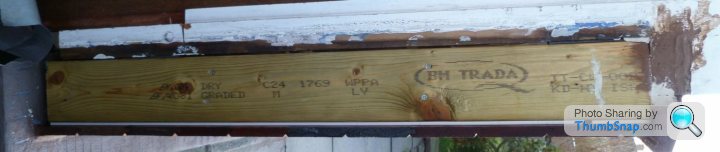
I have some exposed timber, and my question is - how long can I leave this exposed to the elements?
The wood is marked: EN 14081 "Dry Graded C24 M 1769 WPPA LY KD-H?? ISF TT-CD-00?"
I have included a picture for reference below.
Any help greatly appreciated.
226bhp said:
mph1977 said:
226bhp said:
How do you make a piece of wood tantalising?
tanalising is not something you could do at home it's pumping a perservative into the wood when the whole lot is in a pressure vessel 

How do you know that it is preservative treated? Nothing in that code refers to the presence or type of treatment.
The first code is the British Standard for graded timber. The C24 is the strength, the M stands for machine graded, the WPPA means that the timber is spruce, and the LV means that the timber comes from Latvia.
The dry graded bit only refers to how the strength class was defined (i.e. it was tested when the moisture content was around 20%).
A few months should be fine to leave it exposed. There is no hard and fast rule about how quickly a piece of timber will start to decay, however Spruce in this instance would normally be considered not durable (the lowest durability rating) so can be subject to decay fairly quickly.
Check that there is no water trapped in the wall (or whatever that picture was of) and then get it closed up and watertight ASAP.
The first code is the British Standard for graded timber. The C24 is the strength, the M stands for machine graded, the WPPA means that the timber is spruce, and the LV means that the timber comes from Latvia.
The dry graded bit only refers to how the strength class was defined (i.e. it was tested when the moisture content was around 20%).
A few months should be fine to leave it exposed. There is no hard and fast rule about how quickly a piece of timber will start to decay, however Spruce in this instance would normally be considered not durable (the lowest durability rating) so can be subject to decay fairly quickly.
Check that there is no water trapped in the wall (or whatever that picture was of) and then get it closed up and watertight ASAP.
Skodasupercar said:
How do you know that it is preservative treated? Nothing in that code refers to the presence or type of treatment.
The first code is the British Standard for graded timber. The C24 is the strength, the M stands for machine graded, the WPPA means that the timber is spruce, and the LV means that the timber comes from Latvia.
The dry graded bit only refers to how the strength class was defined (i.e. it was tested when the moisture content was around 20%).
A few months should be fine to leave it exposed. There is no hard and fast rule about how quickly a piece of timber will start to decay, however Spruce in this instance would normally be considered not durable (the lowest durability rating) so can be subject to decay fairly quickly.
Check that there is no water trapped in the wall (or whatever that picture was of) and then get it closed up and watertight ASAP.
Matey, you are getting lost in the technical aspect. That piece of timber should I assume be fine. The first code is the British Standard for graded timber. The C24 is the strength, the M stands for machine graded, the WPPA means that the timber is spruce, and the LV means that the timber comes from Latvia.
The dry graded bit only refers to how the strength class was defined (i.e. it was tested when the moisture content was around 20%).
A few months should be fine to leave it exposed. There is no hard and fast rule about how quickly a piece of timber will start to decay, however Spruce in this instance would normally be considered not durable (the lowest durability rating) so can be subject to decay fairly quickly.
Check that there is no water trapped in the wall (or whatever that picture was of) and then get it closed up and watertight ASAP.
I'm surprised with such knowledge of what the lettering stands for that you didn't know straight off how I knew its been tantalised (Persevered).
Its the colour of the timber that gives it away . ............. Simples

Edited by Wozy68 on Monday 30th December 13:12
Wozy68 said:
Matey, you are getting lost in the technical aspect. That piece of timber should I assume be fine.
I'm surprised with such knowledge of what the lettering stands for that you didn't know straight off how I knew its been tantalised (Persevered).
Its the colour of the timber that gives it away . ............. Simples
Just adding a bit of clarity to the jumble of letters in the code I'm surprised with such knowledge of what the lettering stands for that you didn't know straight off how I knew its been tantalised (Persevered).
Its the colour of the timber that gives it away . ............. Simples
Edited by anonymous-user on Monday 30th December 13:12

As for colours - I have s
 te colour perception (plus aging of timber and exposure) so don't really see any specific colours in the wood. Many modern preservative treatments are clear as well.
 Treatment doesn't mean bugger all either in this case, as the wood has been cut to length, and I bet the cut ends have not been re-treated with a brush applied preservative. Even pressure impregnation only treats the outer 1-2mm and not the entire section. When treated wood is cut to length, it exposes the untreated core and end grain which loves to such up water and rot.
And FYI Tanalised timber is a trade name (Lonzawood Tanalith E) - its like saying I just bought a hoover (when in fact you got a Dyson).

Skodasupercar said:
Just adding a bit of clarity to the jumble of letters in the code
As for colours - I have ste colour perception (plus aging of timber and exposure) so don't really see any specific colours in the wood. Many modern preservative treatments are clear as well.
Treatment doesn't mean bugger all either in this case, as the wood has been cut to length, and I bet the cut ends have not been re-treated with a brush applied preservative. Even pressure impregnation only treats the outer 1-2mm and not the entire section. When treated wood is cut to length, it exposes the untreated core and end grain which loves to such up water and rot.
And FYI Tanalised timber is a trade name (Lonzawood Tanalith E) - its like saying I just bought a hoover (when in fact you got a Dyson).
Quite, just like 'hoover' it does the job of explaining. As for colours - I have s
te colour perception (plus aging of timber and exposure) so don't really see any specific colours in the wood. Many modern preservative treatments are clear as well. Treatment doesn't mean bugger all either in this case, as the wood has been cut to length, and I bet the cut ends have not been re-treated with a brush applied preservative. Even pressure impregnation only treats the outer 1-2mm and not the entire section. When treated wood is cut to length, it exposes the untreated core and end grain which loves to such up water and rot.
And FYI Tanalised timber is a trade name (Lonzawood Tanalith E) - its like saying I just bought a hoover (when in fact you got a Dyson).
Can you not see the green/grey tint in the picture, a sure sign of dipped/impregnated 'tanalising'.
I doubt that timber beam will rot in the next twenty years or so
Wozy68 said:
Quite, just like 'hoover' it does the job of explaining.
Can you not see the green/grey tint in the picture, a sure sign of dipped/impregnated 'tanalising'.
I doubt that timber beam will rot in the next twenty years or so
I can see the grey - a sign of UV based degradation of the surface of the wood. I can't see a green tinge to it (but as mentioned above, my colour perception is horrid (a lack or red colour receptors in my eyes).Can you not see the green/grey tint in the picture, a sure sign of dipped/impregnated 'tanalising'.
I doubt that timber beam will rot in the next twenty years or so
I know we are derailing the thread somewhat here, but I have seen preservative treated spruce totally rotten in 3 years!
Back to the OP - it should be fine in the situation you are using it in!
Skodasupercar said:
Wozy68 said:
Quite, just like 'hoover' it does the job of explaining.
Can you not see the green/grey tint in the picture, a sure sign of dipped/impregnated 'tanalising'.
I doubt that timber beam will rot in the next twenty years or so
I know we are derailing the thread somewhat here, but I have seen preservative treated spruce totally rotten in 3 years! Can you not see the green/grey tint in the picture, a sure sign of dipped/impregnated 'tanalising'.
I doubt that timber beam will rot in the next twenty years or so
Back to the OP - it should be fine in the situation you are using it in!
20 years was meant as per OPs use. Also how water is allowed to sit on/under/trapped within wood, can obviously dictate speed of decay.
Gassing Station | Homes, Gardens and DIY | Top of Page | What's New | My Stuff