
Loft: Insulation and boarding a section.
Discussion


Morning,
Probably just sounding out here but any pointers / observations will be welcome.
Recent house move, typical 70's build with a apex roof and a reasonable attic space which until yesterday, I hadn't really even looked at but now wifelife thinks we need to make it more usable for basically storing crap for the next 67 years.
It appears that it has a very old, very thin layer of insulation between the ceiling joists and somebody has then run some rudimentary boards across the joists thus the air gap between ceiling and the boards is only about 3" (ish) which isn't ideal for insulation. It then appears a "professional" outfit have been paid to insulate the loft and have basically rolled out new, albeit pretty thick insulation on the top of the boards.
So, my plan... lift it all. Roll up the new stuff, it's in good shape and decent quality so can go again. Lift the boards and lift the old, rather grotty insulation. Then, lay the newer stuff back down, between the ceiling joists and thus it'll sit proud of the top of the beams by a good 6" or so and therefore I can't board on top, so I'm going to run some 3x2" lengths between the apex beams, thus creating a sort of suspended frame just above the height of the insulation, which I'll then put boards over to create a storage platform.
I'm not doing the entire loft like this, just a platform to store crap and I'll add a support leg mid way on the new cross lengths, down tot he ceiling beams just to give a bit more support. I did debate those plastic loft leg kits but they'll be way too high, not excessively so but still a bit much I think (?) Then, redistribute the old insulation in any gaps and / or buy some more new stuff. I also noted that somebody back in the day has stapled some of the old, thin insulation between the apex beams, ie tot he underside of the roof boards and that's not good so that'll all come down. I do have four, fairly recent roof vents and the space seems dry aside for a bit localised white mould around said poorly thought out apex insulation so I assume it's trapping moisture / sweating the rood boards.
B&q for three (maybe) packs of their bog standard 3 x 0.3m x 1.22m chipboard packs at £13.47 each as I can't really see any cheaper option (?) and then an extra roll of 175mm to 200mm insulation. And yes, full suit, gloves, eye gear and a decent filter mask but even then I'm not loving the idea of having to take down 40yr old insulation from the roof but I'll have to bag it up there then take it out through the house.
So, again more sounding off... and delaying actually having to go and do it but any thoughts, pointers or potential pitfalls with my grand plans? I don't think I have vented sofits and we have dormer windows in the rooms below so I think I can run the insulation right across in the eaves with creating any issues?
Cheers
Probably just sounding out here but any pointers / observations will be welcome.
Recent house move, typical 70's build with a apex roof and a reasonable attic space which until yesterday, I hadn't really even looked at but now wifelife thinks we need to make it more usable for basically storing crap for the next 67 years.
It appears that it has a very old, very thin layer of insulation between the ceiling joists and somebody has then run some rudimentary boards across the joists thus the air gap between ceiling and the boards is only about 3" (ish) which isn't ideal for insulation. It then appears a "professional" outfit have been paid to insulate the loft and have basically rolled out new, albeit pretty thick insulation on the top of the boards.
So, my plan... lift it all. Roll up the new stuff, it's in good shape and decent quality so can go again. Lift the boards and lift the old, rather grotty insulation. Then, lay the newer stuff back down, between the ceiling joists and thus it'll sit proud of the top of the beams by a good 6" or so and therefore I can't board on top, so I'm going to run some 3x2" lengths between the apex beams, thus creating a sort of suspended frame just above the height of the insulation, which I'll then put boards over to create a storage platform.
I'm not doing the entire loft like this, just a platform to store crap and I'll add a support leg mid way on the new cross lengths, down tot he ceiling beams just to give a bit more support. I did debate those plastic loft leg kits but they'll be way too high, not excessively so but still a bit much I think (?) Then, redistribute the old insulation in any gaps and / or buy some more new stuff. I also noted that somebody back in the day has stapled some of the old, thin insulation between the apex beams, ie tot he underside of the roof boards and that's not good so that'll all come down. I do have four, fairly recent roof vents and the space seems dry aside for a bit localised white mould around said poorly thought out apex insulation so I assume it's trapping moisture / sweating the rood boards.
B&q for three (maybe) packs of their bog standard 3 x 0.3m x 1.22m chipboard packs at £13.47 each as I can't really see any cheaper option (?) and then an extra roll of 175mm to 200mm insulation. And yes, full suit, gloves, eye gear and a decent filter mask but even then I'm not loving the idea of having to take down 40yr old insulation from the roof but I'll have to bag it up there then take it out through the house.
So, again more sounding off... and delaying actually having to go and do it but any thoughts, pointers or potential pitfalls with my grand plans? I don't think I have vented sofits and we have dormer windows in the rooms below so I think I can run the insulation right across in the eaves with creating any issues?
Cheers
Edited by Davie on Thursday 11th November 10:35
The plastic loft stilts are the height they are to allow for the recommended 270mm of loft insulation that is current government recommendation.
I'm about to install them in our loft, even though they look crazy. I'll almost need to put a step in from the top of the new loft ladder to get up onto the boards!
I'm about to install them in our loft, even though they look crazy. I'll almost need to put a step in from the top of the new loft ladder to get up onto the boards!
SHutchinson said:
The plastic loft stilts are the height they are to allow for the recommended 270mm of loft insulation that is current government recommendation.
I'm about to install them in our loft, even though they look crazy. I'll almost need to put a step in from the top of the new loft ladder to get up onto the boards!
Yep.I'm about to install them in our loft, even though they look crazy. I'll almost need to put a step in from the top of the new loft ladder to get up onto the boards!
Our place is newish build (2012) so I used the plastic loft stilts when added a central floorspace in loft last summer.
Much easier, quicker (and cheaper at current timber prices) than what OP is proposing.
And yes, the step needed around loft hatch is the only fly in the soup, but its not that much of an issue for me as was not covering whole loft area.
Hmmm, you've got me thinking now.
Just rechecked what I have and I have 4" / 100mm ceiling joists, then the crappy flooring on top of those then the new 200mm insulation.
If I lift it all then drop the newer 200mm insulation between the joists, that'll sit proud of the top of said joists by say 100mm but then if the recommendation is 270mm then that leaves 170mm from the top of the ceiling joists to the top of the theoretical new insulation - in which case the plastic legs at 175mm to 200mm don't actually seem that high after all.
I'm now sat debating still running lengths of 3 x 2" parallel to the ceiling joists, albeit about 200mm higher and attached to the apex beams at each end then lay my new flooring on top of that... or just go and get a pack or two of the flooring legs and just build my flooring on to that instead. I'm sure I can easily get to the 270mm (ish) given the amount of insulation I have, granted the old stuff is old but it works (just not nailed to the underside of my roof boards) Cost is neither here nor there, I have four decent lengths of new 3 x 2 from a fence build and the plastic leg kits are about £15 for ten, give or take. Just now debating which is the better / easier options.
I'm not going to be too caught up on the 270mm either given we have dormer windows with a flat roof above thus I don't deny that'll be the weakest link and there's not much can be done there without major intervention, but it's more an exercise in fixing any existing insulation based issues, getting a reasonable storage platform built and not creating any new issues in the process!
Just rechecked what I have and I have 4" / 100mm ceiling joists, then the crappy flooring on top of those then the new 200mm insulation.
If I lift it all then drop the newer 200mm insulation between the joists, that'll sit proud of the top of said joists by say 100mm but then if the recommendation is 270mm then that leaves 170mm from the top of the ceiling joists to the top of the theoretical new insulation - in which case the plastic legs at 175mm to 200mm don't actually seem that high after all.
I'm now sat debating still running lengths of 3 x 2" parallel to the ceiling joists, albeit about 200mm higher and attached to the apex beams at each end then lay my new flooring on top of that... or just go and get a pack or two of the flooring legs and just build my flooring on to that instead. I'm sure I can easily get to the 270mm (ish) given the amount of insulation I have, granted the old stuff is old but it works (just not nailed to the underside of my roof boards) Cost is neither here nor there, I have four decent lengths of new 3 x 2 from a fence build and the plastic leg kits are about £15 for ten, give or take. Just now debating which is the better / easier options.
I'm not going to be too caught up on the 270mm either given we have dormer windows with a flat roof above thus I don't deny that'll be the weakest link and there's not much can be done there without major intervention, but it's more an exercise in fixing any existing insulation based issues, getting a reasonable storage platform built and not creating any new issues in the process!
Davie said:
I'm not going to be too caught up on the 270mm either given we have dormer windows with a flat roof above thus I don't deny that'll be the weakest link and there's not much can be done there without major intervention, but it's more an exercise in fixing any existing insulation based issues, getting a reasonable storage platform built and not creating any new issues in the process!
Agree - we've gone for 200mm as wanted to maintain being able to stand up in the loft. It's marginal gains between 200-270mm.A quick question, given up currently in said attic (thus far have removed a redundant water tank, some bed legs and a smashed up Mini Dinky toy) however I'm not sure if the insulation should run right out to touch the eaves.
My house is basically a apex roof bungalow, with bedooms in the apex with dormer windows so my sofits are at the ground floor ceiling height and thus my attic space is a triangle in the apex, not the full width of the house footprint. Therefore if I go in the attic, right to the eaves where my ceiling joists meets the apex joists... I can look diagonally down the cavity between the roof itself and what would be the sloped ceiling upstairs / above the stairwell. This void extends right down to the ground floor ceiling height.
Obviously non insulated as such, hence I'm not trying to be grade A with the loft space insulation but having checked my sofits, they're not vented so my questions (eventually) is should I stop my loft floor insulation say 6" short of the eaves thus keeping this gap free or would it be ok to run the insulation right over to touch the eaves / underside of the roof boards. I'm not sure if the latter would create ventilation issues or if either option is neither here nor there.
Pictures would help I'm sure!
My house is basically a apex roof bungalow, with bedooms in the apex with dormer windows so my sofits are at the ground floor ceiling height and thus my attic space is a triangle in the apex, not the full width of the house footprint. Therefore if I go in the attic, right to the eaves where my ceiling joists meets the apex joists... I can look diagonally down the cavity between the roof itself and what would be the sloped ceiling upstairs / above the stairwell. This void extends right down to the ground floor ceiling height.
Obviously non insulated as such, hence I'm not trying to be grade A with the loft space insulation but having checked my sofits, they're not vented so my questions (eventually) is should I stop my loft floor insulation say 6" short of the eaves thus keeping this gap free or would it be ok to run the insulation right over to touch the eaves / underside of the roof boards. I'm not sure if the latter would create ventilation issues or if either option is neither here nor there.
Pictures would help I'm sure!

Davie said:
I'm now sat debating still running lengths of 3 x 2" parallel to the ceiling joists, albeit about 200mm higher and attached to the apex beams at each end then lay my new flooring on top of that... or just go and get a pack or two of the flooring legs and just build my flooring on to that instead. I'm sure I can easily get to the 270mm (ish) given the amount of insulation I have, granted the old stuff is old but it works (just not nailed to the underside of my roof boards) Cost is neither here nor there, I have four decent lengths of new 3 x 2 from a fence build and the plastic leg kits are about £15 for ten, give or take. Just now debating which is the better / easier options.
Bear in mind unless the wood your adding ties into the walls properly, all your doing is adding more weight loading to the ceiling.The weight capacity of a regular ceiling isn't very much which is why I went for the plastic legs.
A solution to this is to press the existing insulation between the joists and lay some Celotex across the top and then place some thin ply on top of that. That way you improve the insulation and gain a surface to put your stuff on all without adding too much weight. The Celotex has, I think, a far better thermal property than normal loft insulation.

steve-V8s said:
A solution to this is to press the existing insulation between the joists and lay some Celotex across the top and then place some thin ply on top of that. That way you improve the insulation and gain a surface to put your stuff on all without adding too much weight. The Celotex has, I think, a far better thermal property than normal loft insulation.
Yes, replacing the whole lot with Celotex would be best.Davie said:
Yes, cover the void but leave room for ventilation. From a recent thread:TA14 said:
Sheepshanks said:
Equus said:
This is a 'good' eaves detail for a cavity wall:
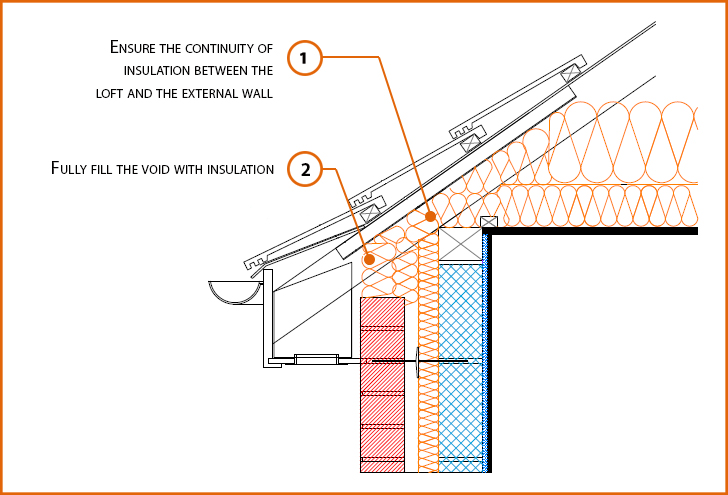
I've been looking at this sort of thing and wondering/ hoping it will help:
https://www.arcbuildingsolutions.co.uk/products/ea... For clarity, the green stuff is part of the product too - it's not just a tray.
The other thing not shown in the diagram is cavity ventilation - air brick, perpen vents or vent over the outer leaf.
The existing cavity ins may not reach that high making the detail difficult to achieve.
Ahhh, right... noted on the eaves / void element but given the design of my apex roof, ie it runs right down to the ceiling height on the ground floor, that means it must be about 10 to 15ft diagonally down so trying to fill that with insulation would be a task and a half, if that's even what I should be doing but maybe I've misunderstood.
I think I'm quite happy to carry on with what I have / buying additional basic rockwool as I fear spending lots on high tech stuff would be futile given my flat roof dormers and my extended roof void down the eaves which will be doing little to help matters as far as heat loss goes. I'll run the new insulation out to the eaves, covering that void but beyond that I'm limited in what I can do as far at the roof void on the sloped roof goes sadly. I does appear to have a foil back, 1" thick sort of foam "Kingspan" esque material on to of the plaster.
Also found an old wasp nest... I say old but what I mean is, I hope it's old.
Thanks chaps.
I think I'm quite happy to carry on with what I have / buying additional basic rockwool as I fear spending lots on high tech stuff would be futile given my flat roof dormers and my extended roof void down the eaves which will be doing little to help matters as far as heat loss goes. I'll run the new insulation out to the eaves, covering that void but beyond that I'm limited in what I can do as far at the roof void on the sloped roof goes sadly. I does appear to have a foil back, 1" thick sort of foam "Kingspan" esque material on to of the plaster.
Also found an old wasp nest... I say old but what I mean is, I hope it's old.
Thanks chaps.
Shieldsy94 said:
In terms of these plastic joist stands to raise the floor to the 270mm, how does that work with a loft ladder?
You need to leave an area down at the original level for the ladder to sit in, basically a recess. Ideally make this recess area big enough to be able to step onto and then up onto the higher level. The fact that this is a small area that wont have the full insulation thickness isn't a big deal in reality.Jakg said:
Bear in mind unless the wood your adding ties into the walls properly, all your doing is adding more weight loading to the ceiling.
The weight capacity of a regular ceiling isn't very much which is why I went for the plastic legs.
I'm a little confused by this. The weight capacity of a regular ceiling isn't very much which is why I went for the plastic legs.
If I use plastic legs, all the weight will be distributed across the ceiling joists, fairly centrally within the loft space.
My wooden baton thought process was to screw each end of the 3 x 2 to the apex beam, thus running across the loft width ways and parallel to the ceiling joints, albeit about 200mm higher to clear the insulation... adding a small support leg mid way thus the weight of the platform which is the whole point of this, would be shared between the apex beams and supported on the ceiling beam.
Caveat being, I'm no structural engineer nor joiner...
TA14 said:
Yes, cover the void but leave room for ventilation. From a recent thread:
Again, probably me me dim but if I cover the void, I'm basically bridging the gap and thus stopping any ventilation coming up from the sofits way below or going down from the attic space? It definitely ventilates up this cavity as I can see cobwebs moving around down inside it. In fact the more I think about this, the more futile the loft space seems given I've a higher area of ceilings that are sloped upstairs, thus above is the void then my roof and so I'm probably loosing most my heat that way whereas the loft floor itself is only about 15ft wide and really only above the hall and encroaches a small way above the bedroom ceilings, the remainder being within the dormer windows and their flat roof.
This started off as a simple "Can you put the Christmas stuff up the loft once we're done with it"
Davie said:
Jakg said:
Bear in mind unless the wood your adding ties into the walls properly, all your doing is adding more weight loading to the ceiling.
The weight capacity of a regular ceiling isn't very much which is why I went for the plastic legs.
I'm a little confused by this. The weight capacity of a regular ceiling isn't very much which is why I went for the plastic legs.
If I use plastic legs, all the weight will be distributed across the ceiling joists, fairly centrally within the loft space.
My wooden baton thought process was to screw each end of the 3 x 2 to the apex beam, thus running across the loft width ways and parallel to the ceiling joints, albeit about 200mm higher to clear the insulation... adding a small support leg mid way thus the weight of the platform which is the whole point of this, would be shared between the apex beams and supported on the ceiling beam.
aeropilot said:
What the poster meant was, you are adding more dead load from the extra timber baton being added above the existing joists, plus the boarding on top of that.
Ok, understood. Although said timber baton would be attached to the roof beams at either end thus no load on the ceiling joists at all... unless I add a small support post half way to tie the two together, but load would be minimal. Not at that stage yet, so open to either option at this stage and if the baton / suspended platform off the roof beams isn't wise, no worries to go with the posts. Edit: To add to that, I've since discovered four rather heavy old internal doors lurking under the most recently laid insulation along with what appears to be the remains on a big wardrobe and many floor boards, all of which have been cobbled together to make the existing attic floor but on top of the ceiling beams with only a very thin, old layer of insulation between... then the new stuff on top of that which I'm sure works, but it's just a bit lazy. Removing all this excess wood will inevitably shed some weight too.
Edited by Davie on Thursday 11th November 13:25

Excusing the mess, this is what I have... to the left is where my dormer extends out from thus no void down the roof space and to the right, the void down the roof space that goes down to ground floor ceiling level. Incidentally, the white mould is only in small areas and mostly where somebody has pushed insulation up between the rood beams, some of which was covering the void I refer to... which makes me think that's a bad idea.
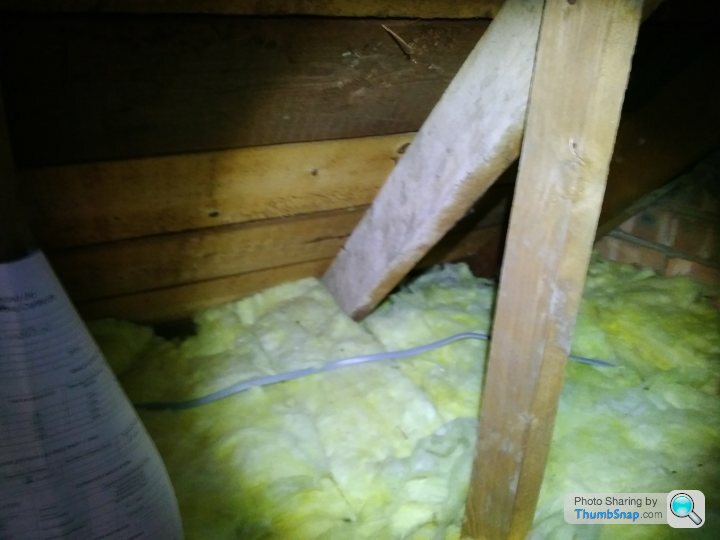
A small bit I've done having removed the redundant water tank and found no insulation at all in that area. So insulation right out to the roof boards, thus covering the void but I'm now unsure if that's wise or if I should pull it back to allow air to circulate down the roof void and up into the attic space? Given the mouldy bits sort of coincide with where poorly thought out insulation was put in the roof beams and down to the void would suggest keeping said void free to ventilate up in to the attic is wise.
Edited by Davie on Thursday 11th November 13:16
Edited by Davie on Thursday 11th November 13:21

Gassing Station | Homes, Gardens and DIY | Top of Page | What's New | My Stuff