
Caterham Cars CEO steps down after 10 years
Bob Laishley takes on the challenge of steering Caterham into an electrified future as Graham Macdonald retires
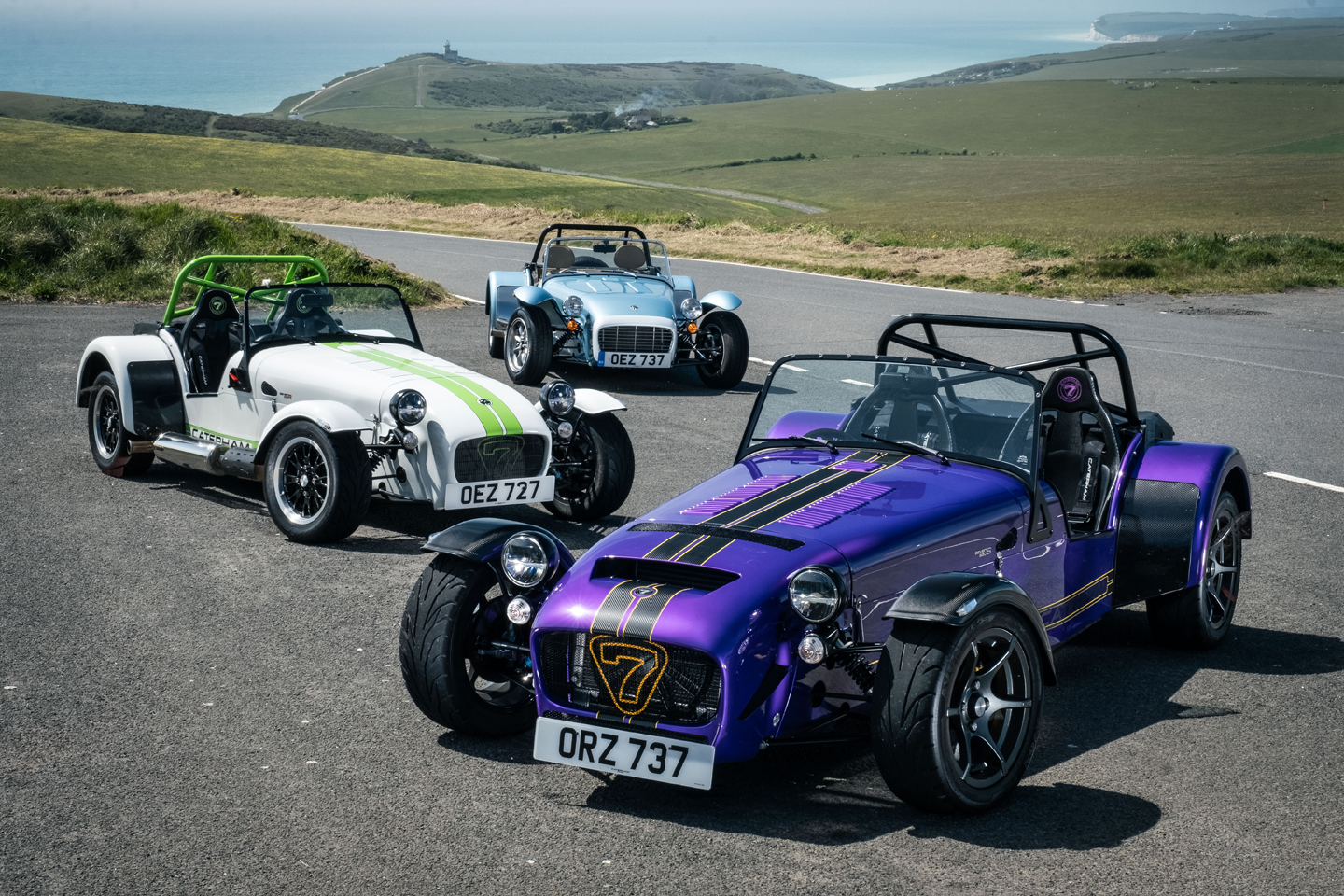
Graham Macdonald, a 15-year veteran of Caterham Cars - a decade of it spent as CEO - has decided to step away from the business and retire. He will be replaced by Bob Laishley, the former Nissan executive brought in by owner VT Holdings just last year to help guide the firm into the electrified era. He will swap his current position as Chief Strategic Officer for chief exec at the start of next month.
His in-tray will be considerable. Macdonald is said to have left the firm with an order book of nearly 12 months after Caterham enjoyed its best-ever sales year in 2021. But Caterham faces an inevitable uphill battle in its medium-term future, as the pressures of increasingly stringent regulations and the myriad problems associated with the eventual transition to battery-electric power hove into view.
Obviously Laishley’s time in the job already will have left him ideally positioned him for what lies ahead, as does the quarter of a century he spent at Nissan, which included a lengthy stint as Global Sportscar Programme Director. When he was appointed, Macdonald talked up the prospect of an all-electric Seven joining the existing lineup in 2023; still no sign of that car yet, but Caterham has always been keen to remind everyone that Laishley has a ‘proven track-record in developing and delivering innovative new products.’
Regardless of what the immediate future holds, the outgoing CEO can look back at his tenure with a sense of pride. Macdonald joined the business in 2007, and spent five years as Chief Financial Officer before he took the reins. Certainly his time in charge was no less challenging under Tony Fernandes’ ownership of the brand; a period which featured both the peaks and troughs of F1 participation, not to mention the aborted partnership with Renault on the Alpine A110 programme.
Laishley said of his former boss: “I would like to thank Graham, on behalf of everyone at Caterham, for his work over the last 15 years. He leaves the business in a strong position following our best ever sales year in 2021 and demand for the Seven at an all-time high.”
Macdonald added: “I would like to take this opportunity to thank the customers, staff, dealers, shareholders and suppliers for their support throughout my time at Caterham. After 15 years, 10 in the role of CEO, it feels like the right time step away and retire. There’s been some massive highs and big challenges along the way, but I can honestly say I’ve relished every bit of my time at Caterham. I’m proud to be leaving the business with a healthy order book and wish Bob and the business all the success in the future.”


Hoping for future success in launching the electric car. Would be great if they could fill the gap in the current range left by the departure of the 1.6 Sigma as well. Would love to know what the plan is…
(Yes, I get there’s the lack of engine noise etc)
Therein lies the problem. An EV 7 will have to be much heavier than an ICE 7
Welcome to the bold new Caterham sEVen! Coming soon to a plug near you!
In-wheel motors and a swappable battery pack under the bonnet. (just an idea).
But would / will Hydrogen ICE or synthetic fuels ever be an option for people like Caterham?
(Yes, I get there’s the lack of engine noise etc)
Therein lies the problem. An EV 7 will have to be much heavier than an ICE 7
20 miles is too low but a reliable 80 in a Caterham would be fine.
(Yes, I get there’s the lack of engine noise etc)
Therein lies the problem. An EV 7 will have to be much heavier than an ICE 7
20 miles is too low but a reliable 80 in a Caterham would be fine.
(Yes, I get there’s the lack of engine noise etc)
For instance, a standard range Model 3 has a 54 kWh battery, which wiki assures me weighs about 324 kg. That's sufficient to drag a car weighing about 1650 kg to 237 WLTP miles.
Going on a purely linear conversion and having that as a range target, assuming a Caterham needs to weight no more than 700 kg, fuelled, then the battery would maybe only need to be about 20 kWh to get a range approaching that of the Tesla, which would be 120 kg.
Seven 420: 595 kg (full tank, no driver)
Subtract
ICE engine etc.: -150 kg (figure above, plus tank, pump etc.)
Add
Motor, charger, inverter etc. +120 kg (Leaf example as given above)
Battery: +120 kg
..and you are at 685 kg. Maybe not a deal-killer? With a 80 kg driver that's 275 hp/tonne for the electric vs 311 hp/tonne for the ICE, and in reality the electric motor could easily be specc'ed to chuck out a lot more than 210 hp. In fact, I think they'd have to work on giving a modest power delivery calibration compared to most EVs otherwise the cars will all be in ditches in seconds

Although the battery as a % of the weight of a Seven counts against it, the fact that its so damn light works for it, shaving a kg from the battery gives a a lot more from each remaining watt compared to a 2 tonne SUV.
There may be a happy balance in something that gives, say, 150 miles of range but which isn't too heavy.
For instance, a standard range Model 3 has a 54 kWh battery, which wiki assures me weighs about 324 kg. That's sufficient to drag a car weighing about 1650 kg to 237 WLTP miles.
Going on a purely linear conversion and having that as a range target, assuming a Caterham needs to weight no more than 700 kg, fuelled, then the battery would maybe only need to be about 20 kWh to get a range approaching that of the Tesla, which would be 120 kg.
Seven 420: 595 kg (full tank, no driver)
Subtract
ICE engine etc.: -150 kg (figure above, plus tank, pump etc.)
Add
Motor, charger, inverter etc. +120 kg (Leaf example as given above)
Battery: +120 kg
..and you are at 685 kg. Maybe not a deal-killer? With a 80 kg driver that's 275 hp/tonne for the electric vs 311 hp/tonne for the ICE, and in reality the electric motor could easily be specc'ed to chuck out a lot more than 210 hp. In fact, I think they'd have to work on giving a modest power delivery calibration compared to most EVs otherwise the cars will all be in ditches in seconds
Although the battery as a % of the weight of a Seven counts against it, the fact that its so damn light works for it, shaving a kg from the battery gives a a lot more from each remaining watt compared to a 2 tonne SUV.
There may be a happy balance in something that gives, say, 150 miles of range but which isn't too heavy.
The range of a EV passenger car is set by that cars drag, not its mass!
A caterham will have less range per unit battery than a Tesla because it has higher drag!
(ok, it might not be higher because the frontal area is smaller, but the Cd is terrible, so it's certianly not much better)
For instance, a standard range Model 3 has a 54 kWh battery, which wiki assures me weighs about 324 kg. That's sufficient to drag a car weighing about 1650 kg to 237 WLTP miles.
Going on a purely linear conversion and having that as a range target, assuming a Caterham needs to weight no more than 700 kg, fuelled, then the battery would maybe only need to be about 20 kWh to get a range approaching that of the Tesla, which would be 120 kg.
Seven 420: 595 kg (full tank, no driver)
Subtract
ICE engine etc.: -150 kg (figure above, plus tank, pump etc.)
Add
Motor, charger, inverter etc. +120 kg (Leaf example as given above)
Battery: +120 kg
..and you are at 685 kg. Maybe not a deal-killer? With a 80 kg driver that's 275 hp/tonne for the electric vs 311 hp/tonne for the ICE, and in reality the electric motor could easily be specc'ed to chuck out a lot more than 210 hp. In fact, I think they'd have to work on giving a modest power delivery calibration compared to most EVs otherwise the cars will all be in ditches in seconds
Although the battery as a % of the weight of a Seven counts against it, the fact that its so damn light works for it, shaving a kg from the battery gives a a lot more from each remaining watt compared to a 2 tonne SUV.
There may be a happy balance in something that gives, say, 150 miles of range but which isn't too heavy.
 t range of 150 miles in actual Caterham use you'd get about 40 from it.
Gassing Station | General Gassing | Top of Page | What's New | My Stuff