
Swirl flaps on an FTO?
Discussion


So, been doing my usual rounds of the classifieds today and the v6 mivec fto caught my eye; though one thing has confused me. It looks as if there are motorised swirl flaps on the plenum, but I can't put my finger on why they would be there. Initially I thought they could be variable length runners but now i'm not so sure. Can anyone shed (pun not intended :P ) any light?

Sardonicus said:
On a petrol car they are usually fitted to change plenum volume 
No they're not, the manifold runners are split so you have 8 feeding a 4 cylinder 16v (one runner per intake valve). One runner is closed at low rpm to encourage high velocity and a swirl motion in the combustion chamber at low rpm. At high rpm both runners are utilised (by opening the swirl flaps) for maximum air flow.227bhp said:
No they're not, the manifold runners are split so you have 8 feeding a 4 cylinder 16v (one runner per intake valve). One runner is closed at low rpm to encourage high velocity and a swirl motion in the combustion chamber at low rpm. At high rpm both runners are utilised (by opening the swirl flaps) for maximum air flow.
Correct. They can fail too..

227bhp said:
No they're not, the manifold runners are split so you have 8 feeding a 4 cylinder 16v (one runner per intake valve). One runner is closed at low rpm to encourage high velocity and a swirl motion in the combustion chamber at low rpm. At high rpm both runners are utilised (by opening the swirl flaps) for maximum air flow.
I knew what I meant but thanks  in real world driving conditions they dont do much anyways dont think they fail on Jap stuff they tend to be made of decent materials rather than the usual poor quality plastic variety i.e VAG/BMW etc
 227bhp said:
No they're not, the manifold runners are split so you have 8 feeding a 4 cylinder 16v (one runner per intake valve). One runner is closed at low rpm to encourage high velocity and a swirl motion in the combustion chamber at low rpm. At high rpm both runners are utilised (by opening the swirl flaps) for maximum air flow.
Yup, on VX cars these are called TwinPort. Definitely noticeable on the Corsa. Think they cut in around 2700 RPM.HappyMidget said:
227bhp said:
No they're not, the manifold runners are split so you have 8 feeding a 4 cylinder 16v (one runner per intake valve). One runner is closed at low rpm to encourage high velocity and a swirl motion in the combustion chamber at low rpm. At high rpm both runners are utilised (by opening the swirl flaps) for maximum air flow.
Yup, on VX cars these are called TwinPort. Definitely noticeable on the Corsa. Think they cut in around 2700 RPM.Sardonicus said:
227bhp said:
No they're not, the manifold runners are split so you have 8 feeding a 4 cylinder 16v (one runner per intake valve). One runner is closed at low rpm to encourage high velocity and a swirl motion in the combustion chamber at low rpm. At high rpm both runners are utilised (by opening the swirl flaps) for maximum air flow.
I knew what I meant but thanks in real world driving conditions they dont do much anyways dont think they fail on Jap stuff they tend to be made of decent materials rather than the usual poor quality plastic variety i.e VAG/BMW etc 
I was going to suggest Google 'T-Vis', but did it anyhow and it brought me back here: http://www.pistonheads.com/gassing/topic.asp?t=126...
Maybe they are what you had in mind.
The OEMs wouldn't have invested so much money into them if they didn't work:
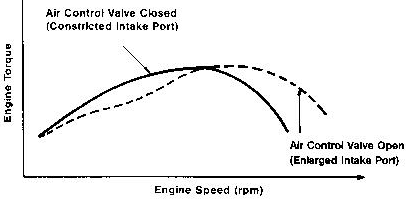
Sadly a lot of armchair tuners dismiss and take them off in pursuit of 'Max BHP'.

Mixture motion is very important. Vizard writes about it at length and it's not a difficult subject to understand, it can't be, I can understand it. I seem to remember there are some pics published on here somewhere of a 2vpc head where you could see evidence of it working. It's a very important part of a diesel head, take a look at these pics and see if you see something out of the ordinary:


That illustrates the lengths manufacturers are going to to promote swirl.
Diesels are low rpm designs.
To much mixture motion induced in the port will effect the flow as rpms increase. So there is a thing as too much swirl or tumble.
Quench is a good thing. The very best US Domestic V8 race engines in naturally aspirated form run enough quench to juuuussstt not be touching.
To much mixture motion induced in the port will effect the flow as rpms increase. So there is a thing as too much swirl or tumble.
Quench is a good thing. The very best US Domestic V8 race engines in naturally aspirated form run enough quench to juuuussstt not be touching.
227bhp said:
Whatever was in your head never made it to the screen
I was going to suggest Google 'T-Vis', but did it anyhow and it brought me back here: http://www.pistonheads.com/gassing/topic.asp?t=126...
Maybe they are what you had in mind.
The OEMs wouldn't have invested so much money into them if they didn't work:
Sadly a lot of armchair tuners dismiss and take them off in pursuit of 'Max BHP'.
Mixture motion is very important. Vizard writes about it at length and it's not a difficult subject to understand, it can't be, I can understand it. I seem to remember there are some pics published on here somewhere of a 2vpc head where you could see evidence of it working. It's a very important part of a diesel head, take a look at these pics and see if you see something out of the ordinary:
That illustrates the lengths manufacturers are going to to promote swirl.
Thanks 227 interesting stuff I was going to suggest Google 'T-Vis', but did it anyhow and it brought me back here: http://www.pistonheads.com/gassing/topic.asp?t=126...
Maybe they are what you had in mind.
The OEMs wouldn't have invested so much money into them if they didn't work:
Sadly a lot of armchair tuners dismiss and take them off in pursuit of 'Max BHP'.
Mixture motion is very important. Vizard writes about it at length and it's not a difficult subject to understand, it can't be, I can understand it. I seem to remember there are some pics published on here somewhere of a 2vpc head where you could see evidence of it working. It's a very important part of a diesel head, take a look at these pics and see if you see something out of the ordinary:
That illustrates the lengths manufacturers are going to to promote swirl.

Gassing Station | Engines & Drivetrain | Top of Page | What's New | My Stuff