
Horrendous parking brake pad wear
Discussion


It seems pretty clear that I need new pads for my 2007 V8 Vantage, as the piston side has worn down to the metal (on both sides of the car).
What causes this? What do I have to fix before I put the new pads in? I've never seen parking brake pads wear. Was the previous owner practicing J-turns in a Bond TikTok??
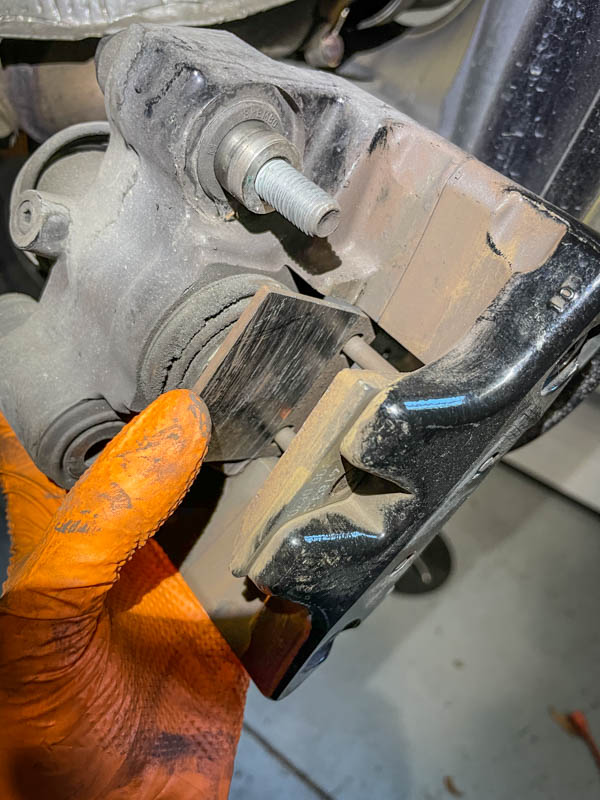
What causes this? What do I have to fix before I put the new pads in? I've never seen parking brake pads wear. Was the previous owner practicing J-turns in a Bond TikTok??
Wear is going to be natural - the pads are always skimming the rotors. The handbrake pads need to be checked as often as the brake pads, I'd be willing to bet that didn't happen here. Also, practically every car I've looked at has had uneven wear - the outer pads and inner pads in the handbrake wear at different rates - so it's important to check both the inner and outer pad on each side, not just the easier-to-see outer pad.
EDIT: looking at the pic, the outer pad is practically new vs the inner pad... so, I'd think the caliper isn't functioning quite right. It's a sliding caliper (look at how the bolts move within it). If the inner and outer pads started out at the same level, and only the inner pads got worn, then I'd **assume** the slider pins aren't sliding to bring in the outer pads, which means only the inner pads are being pushed by the caliper piston.
Rushed response, hopefully didn't get anything mixed up.
EDIT: looking at the pic, the outer pad is practically new vs the inner pad... so, I'd think the caliper isn't functioning quite right. It's a sliding caliper (look at how the bolts move within it). If the inner and outer pads started out at the same level, and only the inner pads got worn, then I'd **assume** the slider pins aren't sliding to bring in the outer pads, which means only the inner pads are being pushed by the caliper piston.
Rushed response, hopefully didn't get anything mixed up.
Edited by telum01 on Thursday 18th February 00:49
I guess you've already wound the piston back in and then put the pad back in place for your picture.
When you wound the piston back in did it move freely? did you check under the rubber boot to make sure the piston has not suffered water ingress and rusted?
If the piston is moving freely then assemble the brakes making sure the pad backing plates are seated snug an lubricated. Make sure you sand down/lubricate the slider pins before installing them as they look a little manky right now. Then once the calliper is mounted back before attaching the handbrake cable pump the brakes a few times to and make sure they engage/release. After this spin the disc by hand and gauge the amount of drag, it should be minimal. If you are happy that the calliper is releasing, reattach your handbrake cable and engage/release the handbrake a few times before spinning the disc again to establish if there is an increase in drag.
The handbrake cable(s) may just be a tiny bit too tight , I presume you have the same uneven wear on both sides ?
When you wound the piston back in did it move freely? did you check under the rubber boot to make sure the piston has not suffered water ingress and rusted?
If the piston is moving freely then assemble the brakes making sure the pad backing plates are seated snug an lubricated. Make sure you sand down/lubricate the slider pins before installing them as they look a little manky right now. Then once the calliper is mounted back before attaching the handbrake cable pump the brakes a few times to and make sure they engage/release. After this spin the disc by hand and gauge the amount of drag, it should be minimal. If you are happy that the calliper is releasing, reattach your handbrake cable and engage/release the handbrake a few times before spinning the disc again to establish if there is an increase in drag.
The handbrake cable(s) may just be a tiny bit too tight , I presume you have the same uneven wear on both sides ?
Mm. The pistons move only with great force. One side I couldn't budge with my thumbs. The pads move freely on the pins. The wear pattern is identical on both sides. The bolt "sleeves" seem to move okay, and I would think that would determine how the pressure was distributed by the two pads, no?
Plan A is to replace the pads and keep an eye on wear and temps after drives.
Plan B is to pull the calipers off and see if they come back to life with a good cleaning and some TLC.
Plan C is the joy of $700 calipers that I don't really need.
Somewhere in there I'll adjust the cables...
Plan A is to replace the pads and keep an eye on wear and temps after drives.
Plan B is to pull the calipers off and see if they come back to life with a good cleaning and some TLC.
Plan C is the joy of $700 calipers that I don't really need.
Somewhere in there I'll adjust the cables...
In practice, the pads in a hydraulic caliper float on the disc. Return is assured by slight deformity of the seals during outward piston movement, and by slight disc run-out, and disc deformation under cornering loads. Mechanical handbrake calipers need an adjustment mechanism, which typically screws out automatically, and therefore must be screwed back manually before new pads can be fitted. These mechanical mechanisms get crusty over time, and the OP probably needs to clean and lubricate. It seems his self-adjusters and/or the handbrake cable are semi-seized.
OP much good info to going on with.
Given that the handbrake caliper is pretty much bullet proof.
It could be that all is working as designed...............just a case of the friction material having come away from the backing plate and the wear adjustment has compensated.
I found to my dismay that when replacing the rotors on my DB9 that the H/B pads (as good as new) had become wedged in their location grooves with rust, a common occurrence with the autos. When tapping (small hammer) the pad back plate to remove it from the caliper so that I could wind the adjuster back the friction material parted from the back plate. As previously mentioned the pads are a Jaguar item.
Given that the handbrake caliper is pretty much bullet proof.
It could be that all is working as designed...............just a case of the friction material having come away from the backing plate and the wear adjustment has compensated.
I found to my dismay that when replacing the rotors on my DB9 that the H/B pads (as good as new) had become wedged in their location grooves with rust, a common occurrence with the autos. When tapping (small hammer) the pad back plate to remove it from the caliper so that I could wind the adjuster back the friction material parted from the back plate. As previously mentioned the pads are a Jaguar item.
The only way the pads can wear like this, assuming they were correctly installed, is for the caliper sliders to be seized, or the pads seized on the sliding pins. If the caliper piston was seized, it would wear both pads pretty evenly, same if the handbrake was left on.
When applying the brake, the piston extends and presses the inner pad onto the disc face. as pressure is applied, the caliper "floats" on its mounts to apply equal and opposite pressure on the outer pad.
As these are single piston calipers, there is no way a seized piston could cause this. It is the sliders.
It can even be seen from the photo that the upper slider in the pic has its rubber seal detached and the sliding surface looks very dry, it should be well lubricated.
https://www.pistonheads.com/gassing/topic.asp?t=17...
When applying the brake, the piston extends and presses the inner pad onto the disc face. as pressure is applied, the caliper "floats" on its mounts to apply equal and opposite pressure on the outer pad.
As these are single piston calipers, there is no way a seized piston could cause this. It is the sliders.
It can even be seen from the photo that the upper slider in the pic has its rubber seal detached and the sliding surface looks very dry, it should be well lubricated.
https://www.pistonheads.com/gassing/topic.asp?t=17...
Edited by 8Tech on Thursday 18th February 17:30

It can even be seen from the photo that the upper slider in the pic has its rubber seal detached and the sliding surface looks very dry, it should be well lubricated.
https://www.pistonheads.com/gassing/topic.asp?t=17...
[/quote]
Caliper in question does not have matching sealing boots from new, unit illustrated matches up to new and s/h units as illustrated on a marque specialists web site.
https://www.pistonheads.com/gassing/topic.asp?t=17...
Edited by 8Tech on Thursday 18th February 17:30
[/quote]
Caliper in question does not have matching sealing boots from new, unit illustrated matches up to new and s/h units as illustrated on a marque specialists web site.
Tremelune said:
Interesting. I've also read that sometimes the pad material just...falls off after many years. When the new pads come, I'll take some time to clean, lube, and adjust see what happens.
Per previous threads, the piston is wound back using the two holes in the face to rotate it clockwise, it should turn pretty easily and smoothly, I used a pair of long nosed pliers after splitting the caliper by taking out the two Trox bolts that are painted black, or just use a rewind tool of course. The piston dust seal looks quite perished on yours but that also might just be road dirt.You need new slider rubber gaiters by the looks of it, don't know where in the States but they are hard to find here in the UK, I worked with Frentech in the UK, but after some searching we found the right ones. I've posted elsewhere but can dig them them out if you want them. Autofren B5130 is the manufacturer's code.
The sliders do need to be nice and clean and lubricated.
The pads look like they are free to move on their pins. If the caliper carriage is sliding smoothly, and the piston is easy to turn, it does look like the facing materlal has fallen off!! How weird. The wear metal on metal (ouch!) is very even so it looks like there is no twisting or asymmetric alignment. I replaced mine with Brembo ones. Not cheap but not too expensive in the scheme of things. Are they any better? No idea.
Mine do that too, I hadn't thought it would cause the pad material to break off the metal plate but if its not stuck on well, then maybe... would it spin round stuck on the disc going clonk clonk until it fell off?
It's why I leave mine in gear on my fortunately level drive and garage, and only use handbrake when out and about or parking a slope.
It's why I leave mine in gear on my fortunately level drive and garage, and only use handbrake when out and about or parking a slope.
I took these apart, cleaned them up, and replaced the pads. I suspect the pad material simply...fell off both sides recently (not crazy for 15 years). I drove the pins out with a vice and sanded the rust off. One or two of the sliding cylinders were a bit stiff, but nothing crazy. I was able to wind the piston back in with a pair of needle-nose pliers (pressing them in straight, ah, just doesn't work...for now-obvious reasons). In any event, I lubed them up (along with the pins, spring, and backs of the pads) and I'll keep an eye on things.
That said, I couldn't get the calipers off! There is a step in the factory manual that rather boldly states "Release handbrake cable adjustment (both sides)." How is this done?
I managed to unhook the "eye" that attaches to the spring, but I could not for the life of me get the black plastic grommet thing around the cable to push through the caliper...I tried pushing the little feet in with a screwdriver to no avail...How do these things come off?? I wish I'd gotten a picture.
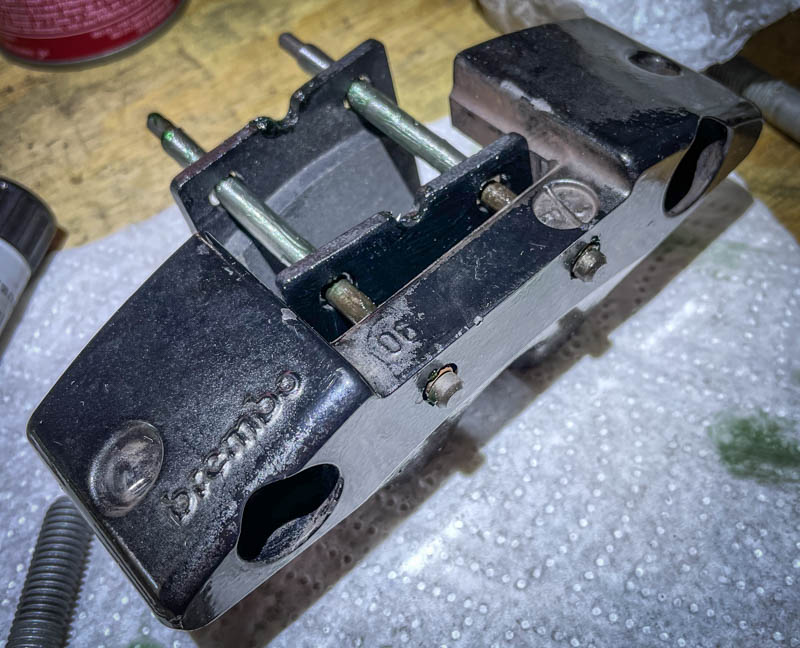
That said, I couldn't get the calipers off! There is a step in the factory manual that rather boldly states "Release handbrake cable adjustment (both sides)." How is this done?
I managed to unhook the "eye" that attaches to the spring, but I could not for the life of me get the black plastic grommet thing around the cable to push through the caliper...I tried pushing the little feet in with a screwdriver to no avail...How do these things come off?? I wish I'd gotten a picture.
To remove the cable from the assembly there is an expanding plastic clip which needs squeezing in around it's circumference to allow the cable to be extracted. This was discussed in the following thread.
https://www.pistonheads.com/gassing/topic.asp?t=17...
I also found it a right PITA to get the cable back on to the actuator on the caliper and found the easiest way was to install the caliper without the pads, reattached the cable and then fit the pads, this assumes nice clean discs with no lips on the edge.
https://www.pistonheads.com/gassing/topic.asp?t=17...
I also found it a right PITA to get the cable back on to the actuator on the caliper and found the easiest way was to install the caliper without the pads, reattached the cable and then fit the pads, this assumes nice clean discs with no lips on the edge.
BigMig said:
I also found it a right PITA to get the cable back on to the actuator on the caliper and found the easiest way was to install the caliper without the pads, reattached the cable and then fit the pads, this assumes nice clean discs with no lips on the edge.
Thick cable tie round the neck of the cable, just below the eye, then before you pull it tight, slip another one into the loop of the first one. Pull the first tight and loop the second, so you're effectively creating two joined cable ties with one tightened up on the neck. Use the loop in the second to act as a retainer for a large screwdriver and then use the screwdriver on the body of the caliper to act as a lever for hooking the eye over the actuator.Put some tape or cardboard on the body of the caliper to prevent the screwdriver damaging the paint.
Sounds complicated and difficult to describe, but works !
Gassing Station | Aston Martin | Top of Page | What's New | My Stuff